
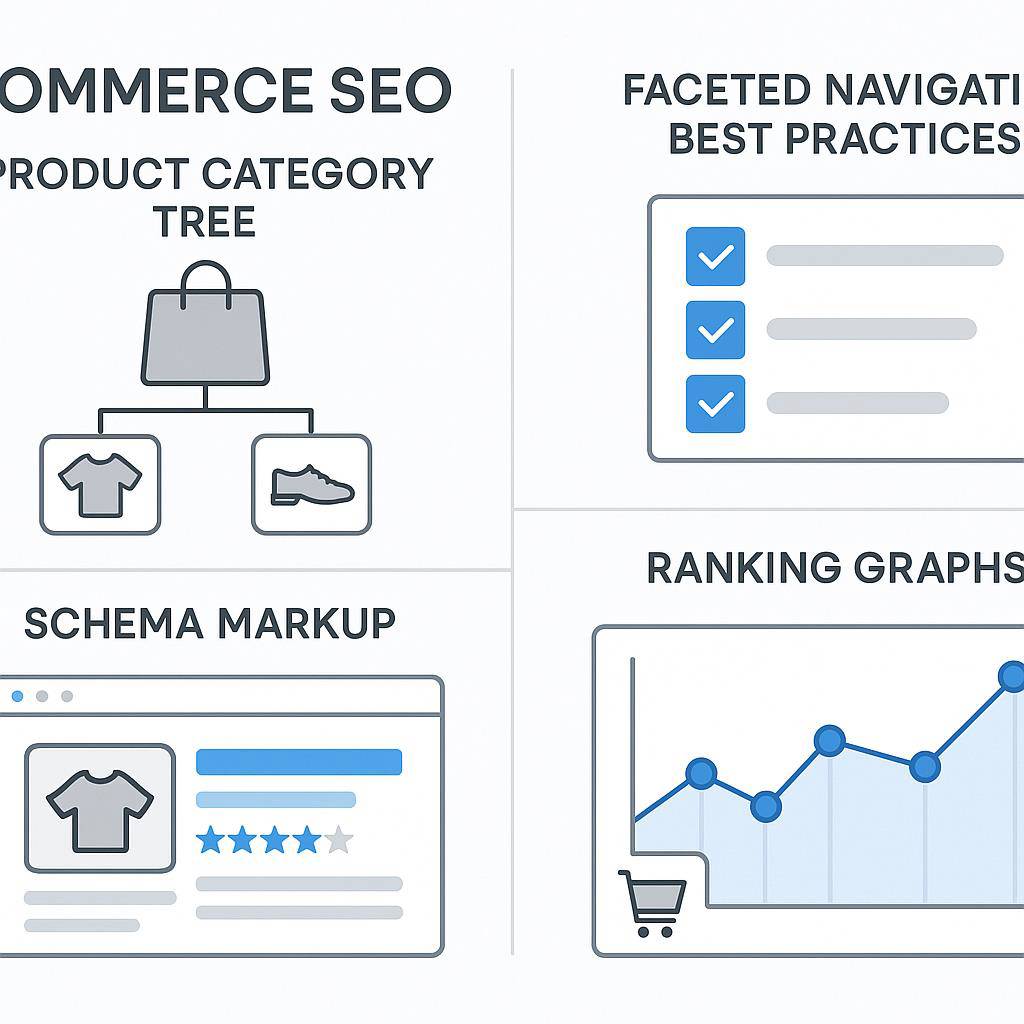
Win high-intent traffic across thousands of SKUs
Capturing profitable demand at scale requires more than generic tactics. Brands with large catalogs need e-commerce SEO services engineered for crawl efficiency, category depth, and conversion-focused product detail pages. The goal is simple: win high-intent traffic across thousands of SKUs without bloating indexation, duplicating content, or eroding margins.
Modern ecommerce SEO aligns technical architecture, content production, and brand authority. When those pillars work in sync, you rank for head terms and long-tail queries (models, sizes, colors, compatibility), while reducing dependency on paid acquisition. Expect faster time-to-value from technical fixes that remove crawl blockers, and compounding gains from category hubs, PDP enhancements, and authoritative mentions.
Whether you manage 500 SKUs or 500,000, the playbook prioritizes: crawlability and speed, indexation rules for filters, best-in-class on-page patterns, content at scale, and digital PR. Below is a practical roadmap to deploy enterprise-grade ecommerce SEO that builds durable rankings and revenue.
Quick Summary: Architecture, content, and authority
Winning organic market share in ecommerce comes down to three connected levers:
- Architecture: Clean URL structures, logical category trees, controlled faceted navigation, and precise indexation rules that focus Googlebot where it matters.
- Content: Category hubs, optimized PDPs, comparison pages, guides, FAQs, and UGC that capture long-tail intent and reduce bounce.
- Authority: Digital PR, strategic partnerships, and affiliate programs that drive high-quality mentions and links.
In your first 90 days, prioritize: eliminating crawl waste, improving Core Web Vitals, strengthening category templates, enriching PDPs with structured data, and securing authoritative features. This is the fastest path to meaningful lifts in non-brand traffic and revenue per session.
Tech Foundations: Crawlability, speed, faceted nav controls
Technical excellence is non-negotiable. Search engines must crawl the right pages quickly and render them efficiently. Start with a crawl budget audit and fix the fundamentals:
- Indexation rules: Use robots.txt, meta robots, and canonical tags to prevent duplicate or near-duplicate URLs from filters (e.g., sort, price range) from flooding the index. Allow indexation only for commercially valuable combinations.
- Faceted navigation: Control filters with parameter handling, selective noindex, and self-referencing canonicals. Expose high-demand facets (e.g., brand + category) via static, internally linked pages when search demand is proven.
- Sitemaps: Maintain XML sitemaps for categories, subcategories, and in-stock PDPs. Remove out-of-stock and 404s quickly; refresh lastmod dates to accelerate discovery.
- Rendering & speed: Favor server-side rendering or hybrid hydration. Optimize images (AVIF/WebP), defer non-critical JS, and serve via CDN/edge caching to improve LCP, INP, and CLS.
When technical debt is heavy, align SEO with development sprints and performance workstreams. If you need specialized support, consider Website Development and E-commerce Website enhancements to ship performance improvements faster.
On-Page: Category hubs, PDP optimization, internal linking
Categories are the revenue engines in ecommerce. Architect them as content-rich hubs with smart internal links, while PDPs handle conversion and long-tail specificity.
- Category hubs: Add unique introductions, FAQs, and links to top subcategories/brands. Place expandable content below the product grid to support long-tail without pushing products down.
- PDPs: Structure titles and H1s to include model/variant terms; enrich with Product, Review, and Offer schema; include spec tables, comparison modules, and UGC. Keep descriptions unique and scannable.
- Internal linking: Use breadcrumbs, related categories, and editorial modules that link buyers to top filters or complementary categories. Avoid orphaned PDPs; ensure every SKU has at least two internal paths from hubs.
These on-page patterns consistently lift CTR, average position, and revenue per session—key outcomes of high-performing e-commerce SEO services.
Content at Scale: Guides, comparisons, UGC, FAQs
Consistently winning the SERP requires scalable content systems, not one-off posts. Deploy a library of formats that map to discovery, evaluation, and purchase.
- Buyers’ guides for top categories that clarify use cases, materials, sizing, and compatibility.
- Comparison pages (brand vs. brand, model vs. model) built from structured spec data to capture bottom-funnel intent.
- UGC & FAQs: Curate authentic reviews, Q&A, and customer photos; mark up with FAQ schema where applicable.
- Programmatic SEO: Safely scale templated pages (e.g., size + brand + category) where demand and inventory justify indexation.
Design-rich content improves dwell time and conversion. If you need creative horsepower, tap Graphic Design and Branding Design. For lifecycle amplification, coordinate launches via Email Marketing Services and paid distribution.
Authority & PR: Digital PR, partnerships, affiliates
Authority compounds results when your technical and content layers are solid. Pursue digital PR and partnerships that generate relevant, branded mentions and links.
- Digital PR: Data stories, product launches, and expert commentary to earn coverage from industry and lifestyle publications.
- Partners & affiliates: Build strategic alliances and an affiliate layer to expand reach and acquire high-intent traffic at a predictable cost.
- Category-level outreach: Secure links to your top hubs and buying guides to reinforce topical authority.
Industry-specific campaigns perform remarkably well. For example, a retailer can combine vertical playbooks like Retail Digital Marketing Services and Fashion Digital Marketing Agency, while B2B storefronts can adapt strategies from B2B Digital Marketing. The result is sustainable authority that lifts rankings across thousands of SKUs.
Measurement: Rankings, revenue per session, LTV
Great SEO is measurable SEO. Move beyond vanity metrics and align dashboards to revenue outcomes.
- Rankings & visibility: Monitor category and PDP keyword sets, share of voice, and CTR. Tie ranking movements to deploy dates for causality.
- Revenue per session (RPS): Track organic RPS by category to prioritize templates and content with the highest yield.
- Conversion & AOV: Attribute gains to specific page types (category vs. PDP vs. comparison) to justify scaling similar content.
- LTV by channel: Compare first-purchase ROI to subscriber/returning-buyer LTV to prove compounding value of organic.
Unify GA4, Search Console, and merchandising data in a BI layer. If you need a partner for analytics and automation, explore AI Consulting and cross-channel Digital Marketing Services to operationalize insights.
Recommended Partners: SEO Services and Ecommerce Digital Marketing by TMAT Network
To accelerate execution and avoid costly missteps, partner with specialists who build scalable systems for ecommerce growth:
- SEO Services: Technical audits, on-page optimization, and white-hat link acquisition designed for large catalogs.
- Ecommerce Digital Marketing Services: Integrated growth across SEO, PPC, email/SMS, and CRO for predictable revenue compounding.
Complementary capabilities such as PPC Service and Ecommerce Management Services help you capture demand today while organic gains scale.
Conclusion: Build a durable search moat — schedule an eCom SEO audit
Enterprise-grade e-commerce SEO services compound: technical clarity unlocks crawl, content converts intent, and authority lifts everything. The earlier you align these levers, the faster your non-brand revenue grows and the lower your blended CAC becomes.
Ready to build your search moat? Schedule an ecommerce SEO audit and blueprint your next 90 days with SEO Services or an integrated plan via Ecommerce Digital Marketing Services.
FAQ: How to handle filters? Duplicate content? Content at scale? Link strategy? Measuring ROI?
How should we handle filters and faceted navigation?
Allow indexing only for high-demand combinations (e.g., brand + category) validated by search volume and revenue data. For all other facets, use self-referencing canonicals and meta noindex, follow. Create static landing pages for the few facets that drive meaningful demand and link them from category hubs.
What about duplicate content from variants or sort orders?
Normalize parameters in your canonical URLs, block low-value parameters via robots.txt or tag them noindex, and ensure one canonical PDP per product family. For color/size variants, consolidate to one canonical PDP when the core intent is the same, and expose variant data on-page.
How do we scale content without sacrificing quality?
Use structured briefs, modular templates, and product data feeds to power repeatable formats (comparisons, spec tables, FAQs). Layer in human edits and expert QA. Enrich pages with UGC and visual assets; consider Graphic Design support for premium look-and-feel.
What’s an effective link strategy for ecommerce?
Prioritize digital PR and partnerships that align with your top revenue categories. Aim links at category hubs, buying guides, and flagship PDPs. Complement PR with affiliates and influencers; sector-specific tactics from SaaS Digital Marketing Agency or Logistics Digital Marketing Agency can be adapted to your niche.
How do we measure ROI from SEO?
Track category- and PDP-level revenue per session, assisted conversions, and subscriber LTV. Attribute lifts to specific deployments (tech fixes, new hubs, PR hits) using annotations. Roll up to channel-level CAC vs. LTV to quantify compounding value. For cross-channel lift, pair SEO with selective PPC Service during ramp-up.
{
“@context”:”https://schema.org”,
“@type”:”FAQPage”,
“mainEntity”:[
{“@type”:”Question”,”name”:”How should we handle filters and faceted navigation?”,”acceptedAnswer”:{“@type”:”Answer”,”text”:”Allow indexing only for high-demand combinations validated by search and revenue data. Use self-referencing canonicals and meta noindex, follow for other facets. Create static, internally linked landing pages for valuable combinations.”}},
{“@type”:”Question”,”name”:”What about duplicate content from variants or sort orders?”,”acceptedAnswer”:{“@type”:”Answer”,”text”:”Normalize parameters in canonical URLs, apply robots or noindex to low-value parameters, and ensure one canonical PDP per product family. Consolidate color/size variants when intent is the same and expose variant data on-page.”}},
{“@type”:”Question”,”name”:”How do we scale content without sacrificing quality?”,”acceptedAnswer”:{“@type”:”Answer”,”text”:”Use structured briefs, modular templates, and product data to power comparisons, spec tables, and FAQs. Add human QA, UGC, and quality visuals to maintain E-E-A-T.”}},
{“@type”:”Question”,”name”:”What’s an effective link strategy for ecommerce?”,”acceptedAnswer”:{“@type”:”Answer”,”text”:”Lead with digital PR and partnerships. Target links to category hubs, buying guides, and flagship PDPs. Support with affiliates and influencers relevant to your niche.”}},
{“@type”:”Question”,”name”:”How do we measure ROI from SEO?”,”acceptedAnswer”:{“@type”:”Answer”,”text”:”Track revenue per session, assisted conversions, and LTV by channel. Attribute gains to deployments with annotations and compare CAC vs. LTV for true ROI.”}}
]
}


 Quick Response