TmatNetwork

Category: Digital Marketing Practices

Proven digital marketing practices and workflows used by top agencies to deliver consistent, measurable results for clients.

  • E-commerce SEO Services: The Ultimate Rankings Playbook

    E-commerce SEO Services: The Ultimate Rankings Playbook

    Win high-intent traffic across thousands of SKUs

    Capturing profitable demand at scale requires more than generic tactics. Brands with large catalogs need e-commerce SEO services engineered for crawl efficiency, category depth, and conversion-focused product detail pages. The goal is simple: win high-intent traffic across thousands of SKUs without bloating indexation, duplicating content, or eroding margins.

    Modern ecommerce SEO aligns technical architecture, content production, and brand authority. When those pillars work in sync, you rank for head terms and long-tail queries (models, sizes, colors, compatibility), while reducing dependency on paid acquisition. Expect faster time-to-value from technical fixes that remove crawl blockers, and compounding gains from category hubs, PDP enhancements, and authoritative mentions.

    Whether you manage 500 SKUs or 500,000, the playbook prioritizes: crawlability and speed, indexation rules for filters, best-in-class on-page patterns, content at scale, and digital PR. Below is a practical roadmap to deploy enterprise-grade ecommerce SEO that builds durable rankings and revenue.

    Quick Summary: Architecture, content, and authority

    Winning organic market share in ecommerce comes down to three connected levers:

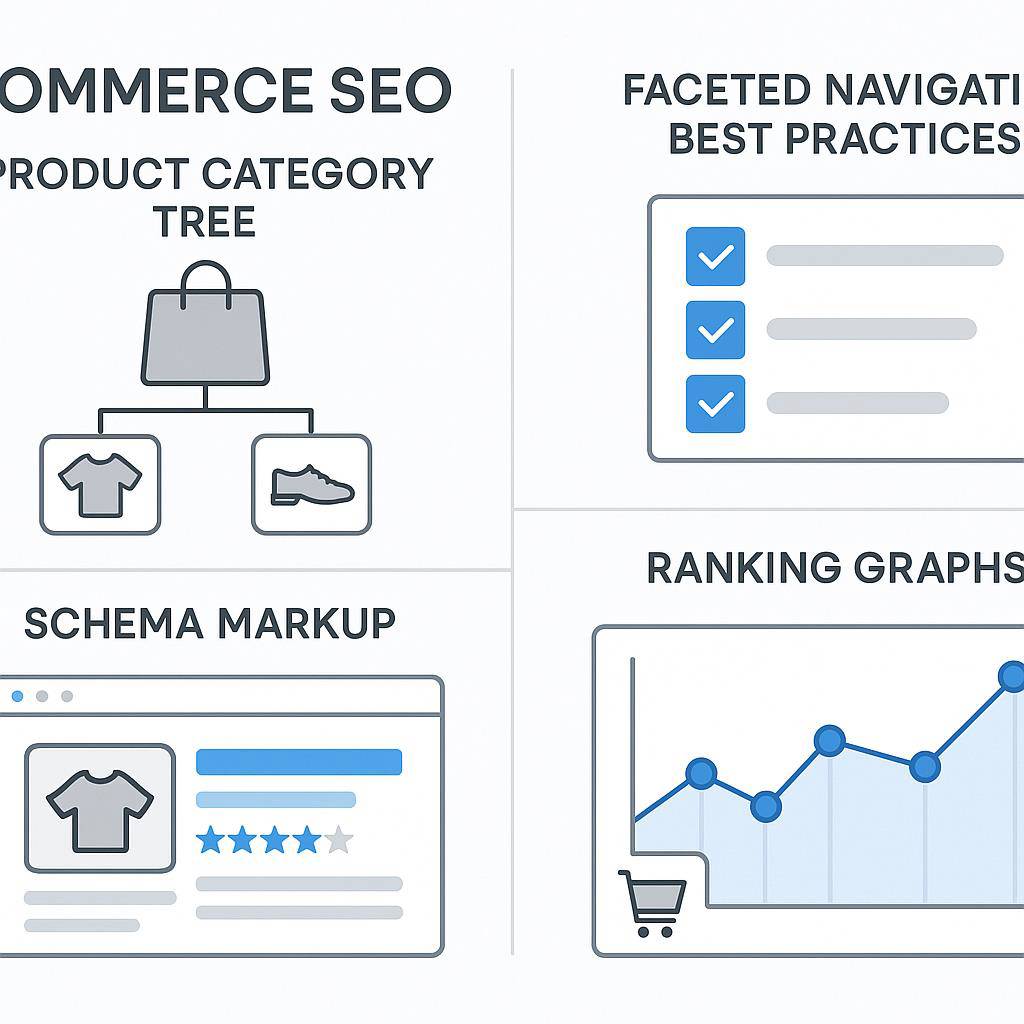
    • Architecture: Clean URL structures, logical category trees, controlled faceted navigation, and precise indexation rules that focus Googlebot where it matters.
    • Content: Category hubs, optimized PDPs, comparison pages, guides, FAQs, and UGC that capture long-tail intent and reduce bounce.
    • Authority: Digital PR, strategic partnerships, and affiliate programs that drive high-quality mentions and links.

    In your first 90 days, prioritize: eliminating crawl waste, improving Core Web Vitals, strengthening category templates, enriching PDPs with structured data, and securing authoritative features. This is the fastest path to meaningful lifts in non-brand traffic and revenue per session.

    Tech Foundations: Crawlability, speed, faceted nav controls

    Technical excellence is non-negotiable. Search engines must crawl the right pages quickly and render them efficiently. Start with a crawl budget audit and fix the fundamentals:

    • Indexation rules: Use robots.txt, meta robots, and canonical tags to prevent duplicate or near-duplicate URLs from filters (e.g., sort, price range) from flooding the index. Allow indexation only for commercially valuable combinations.
    • Faceted navigation: Control filters with parameter handling, selective noindex, and self-referencing canonicals. Expose high-demand facets (e.g., brand + category) via static, internally linked pages when search demand is proven.
    • Sitemaps: Maintain XML sitemaps for categories, subcategories, and in-stock PDPs. Remove out-of-stock and 404s quickly; refresh lastmod dates to accelerate discovery.
    • Rendering & speed: Favor server-side rendering or hybrid hydration. Optimize images (AVIF/WebP), defer non-critical JS, and serve via CDN/edge caching to improve LCP, INP, and CLS.

    When technical debt is heavy, align SEO with development sprints and performance workstreams. If you need specialized support, consider Website Development and E-commerce Website enhancements to ship performance improvements faster.

    On-Page: Category hubs, PDP optimization, internal linking

    Categories are the revenue engines in ecommerce. Architect them as content-rich hubs with smart internal links, while PDPs handle conversion and long-tail specificity.

    • Category hubs: Add unique introductions, FAQs, and links to top subcategories/brands. Place expandable content below the product grid to support long-tail without pushing products down.
    • PDPs: Structure titles and H1s to include model/variant terms; enrich with Product, Review, and Offer schema; include spec tables, comparison modules, and UGC. Keep descriptions unique and scannable.
    • Internal linking: Use breadcrumbs, related categories, and editorial modules that link buyers to top filters or complementary categories. Avoid orphaned PDPs; ensure every SKU has at least two internal paths from hubs.

    These on-page patterns consistently lift CTR, average position, and revenue per session—key outcomes of high-performing e-commerce SEO services.

    Content at Scale: Guides, comparisons, UGC, FAQs

    Consistently winning the SERP requires scalable content systems, not one-off posts. Deploy a library of formats that map to discovery, evaluation, and purchase.

    • Buyers’ guides for top categories that clarify use cases, materials, sizing, and compatibility.
    • Comparison pages (brand vs. brand, model vs. model) built from structured spec data to capture bottom-funnel intent.
    • UGC & FAQs: Curate authentic reviews, Q&A, and customer photos; mark up with FAQ schema where applicable.
    • Programmatic SEO: Safely scale templated pages (e.g., size + brand + category) where demand and inventory justify indexation.

    Design-rich content improves dwell time and conversion. If you need creative horsepower, tap Graphic Design and Branding Design. For lifecycle amplification, coordinate launches via Email Marketing Services and paid distribution.

    Authority & PR: Digital PR, partnerships, affiliates

    Authority compounds results when your technical and content layers are solid. Pursue digital PR and partnerships that generate relevant, branded mentions and links.

    • Digital PR: Data stories, product launches, and expert commentary to earn coverage from industry and lifestyle publications.
    • Partners & affiliates: Build strategic alliances and an affiliate layer to expand reach and acquire high-intent traffic at a predictable cost.
    • Category-level outreach: Secure links to your top hubs and buying guides to reinforce topical authority.

    Industry-specific campaigns perform remarkably well. For example, a retailer can combine vertical playbooks like Retail Digital Marketing Services and Fashion Digital Marketing Agency, while B2B storefronts can adapt strategies from B2B Digital Marketing. The result is sustainable authority that lifts rankings across thousands of SKUs.

    Measurement: Rankings, revenue per session, LTV

    Great SEO is measurable SEO. Move beyond vanity metrics and align dashboards to revenue outcomes.

    • Rankings & visibility: Monitor category and PDP keyword sets, share of voice, and CTR. Tie ranking movements to deploy dates for causality.
    • Revenue per session (RPS): Track organic RPS by category to prioritize templates and content with the highest yield.
    • Conversion & AOV: Attribute gains to specific page types (category vs. PDP vs. comparison) to justify scaling similar content.
    • LTV by channel: Compare first-purchase ROI to subscriber/returning-buyer LTV to prove compounding value of organic.

    Unify GA4, Search Console, and merchandising data in a BI layer. If you need a partner for analytics and automation, explore AI Consulting and cross-channel Digital Marketing Services to operationalize insights.

    Recommended Partners: SEO Services and Ecommerce Digital Marketing by TMAT Network

    To accelerate execution and avoid costly missteps, partner with specialists who build scalable systems for ecommerce growth:

    • SEO Services: Technical audits, on-page optimization, and white-hat link acquisition designed for large catalogs.
    • Ecommerce Digital Marketing Services: Integrated growth across SEO, PPC, email/SMS, and CRO for predictable revenue compounding.

    Complementary capabilities such as PPC Service and Ecommerce Management Services help you capture demand today while organic gains scale.

    Conclusion: Build a durable search moat — schedule an eCom SEO audit

    Enterprise-grade e-commerce SEO services compound: technical clarity unlocks crawl, content converts intent, and authority lifts everything. The earlier you align these levers, the faster your non-brand revenue grows and the lower your blended CAC becomes.

    Ready to build your search moat? Schedule an ecommerce SEO audit and blueprint your next 90 days with SEO Services or an integrated plan via Ecommerce Digital Marketing Services.

    FAQ: How to handle filters? Duplicate content? Content at scale? Link strategy? Measuring ROI?

    How should we handle filters and faceted navigation?

    Allow indexing only for high-demand combinations (e.g., brand + category) validated by search volume and revenue data. For all other facets, use self-referencing canonicals and meta noindex, follow. Create static landing pages for the few facets that drive meaningful demand and link them from category hubs.

    What about duplicate content from variants or sort orders?

    Normalize parameters in your canonical URLs, block low-value parameters via robots.txt or tag them noindex, and ensure one canonical PDP per product family. For color/size variants, consolidate to one canonical PDP when the core intent is the same, and expose variant data on-page.

    How do we scale content without sacrificing quality?

    Use structured briefs, modular templates, and product data feeds to power repeatable formats (comparisons, spec tables, FAQs). Layer in human edits and expert QA. Enrich pages with UGC and visual assets; consider Graphic Design support for premium look-and-feel.

    What’s an effective link strategy for ecommerce?

    Prioritize digital PR and partnerships that align with your top revenue categories. Aim links at category hubs, buying guides, and flagship PDPs. Complement PR with affiliates and influencers; sector-specific tactics from SaaS Digital Marketing Agency or Logistics Digital Marketing Agency can be adapted to your niche.

    How do we measure ROI from SEO?

    Track category- and PDP-level revenue per session, assisted conversions, and subscriber LTV. Attribute lifts to specific deployments (tech fixes, new hubs, PR hits) using annotations. Roll up to channel-level CAC vs. LTV to quantify compounding value. For cross-channel lift, pair SEO with selective PPC Service during ramp-up.

    {
    “@context”:”https://schema.org”,
    “@type”:”FAQPage”,
    “mainEntity”:[
    {“@type”:”Question”,”name”:”How should we handle filters and faceted navigation?”,”acceptedAnswer”:{“@type”:”Answer”,”text”:”Allow indexing only for high-demand combinations validated by search and revenue data. Use self-referencing canonicals and meta noindex, follow for other facets. Create static, internally linked landing pages for valuable combinations.”}},
    {“@type”:”Question”,”name”:”What about duplicate content from variants or sort orders?”,”acceptedAnswer”:{“@type”:”Answer”,”text”:”Normalize parameters in canonical URLs, apply robots or noindex to low-value parameters, and ensure one canonical PDP per product family. Consolidate color/size variants when intent is the same and expose variant data on-page.”}},
    {“@type”:”Question”,”name”:”How do we scale content without sacrificing quality?”,”acceptedAnswer”:{“@type”:”Answer”,”text”:”Use structured briefs, modular templates, and product data to power comparisons, spec tables, and FAQs. Add human QA, UGC, and quality visuals to maintain E-E-A-T.”}},
    {“@type”:”Question”,”name”:”What’s an effective link strategy for ecommerce?”,”acceptedAnswer”:{“@type”:”Answer”,”text”:”Lead with digital PR and partnerships. Target links to category hubs, buying guides, and flagship PDPs. Support with affiliates and influencers relevant to your niche.”}},
    {“@type”:”Question”,”name”:”How do we measure ROI from SEO?”,”acceptedAnswer”:{“@type”:”Answer”,”text”:”Track revenue per session, assisted conversions, and LTV by channel. Attribute gains to deployments with annotations and compare CAC vs. LTV for true ROI.”}}
    ]
    }

  • Affordable Web Design Services in Lagos

    Affordable Web Design Services in Lagos

    In today’s digital-first economy, 84% of consumers research businesses online before making purchasing decisions. Yet many Lagos businesses struggle with a critical dilemma: how to obtain professional web design services without exceeding limited budgets. This comprehensive guide reveals how TmatNetwork delivers high-quality, conversion-focused websites at accessible prices.

    The Web Design Affordability Problem

    Small and medium businesses across Lagos face three core challenges:

    • Upfront costs exceeding ₦500,000 for custom development
    • Monthly retainers consuming 15-20% of marketing budgets
    • Compromised quality from “cheap” solutions damaging brand credibility
    • Ongoing maintenance fees creating financial uncertainty

    These barriers prevent many Nigerian businesses from establishing effective online presences. At TmatNetwork, we’ve addressed these challenges through our specialized web development approach.

    TmatNetwork’s Affordable Solution Framework

    Our methodology combines efficiency with excellence through:

    1. Modular Design System

    We’ve developed 50+ reusable components that accelerate development while maintaining uniqueness. This system cuts costs by 40-60% compared to fully custom builds.

    2. Strategic Feature Prioritization

    Through our UI/UX design process, we identify core functionality that delivers 80% of results for 20% of development time.

    3. Scalable Infrastructure

    Using optimized hosting solutions, we eliminate unnecessary expenses while ensuring performance. Our e-commerce websites handle traffic spikes without premium costs.

    4. Transparent Pricing Models

    Unlike agencies with hidden fees, our service packages offer predictable budgeting with no surprises.

    Global Best Practices, Local Implementation

    While headquartered in Lagos, our affordable web design principles apply universally:

    Solution ElementLagos ImplementationGlobal Application
    Mobile-First DesignOptimized for Nigerian mobile networksGlobal responsive standards
    Payment IntegrationFlutterwave, PaystackStripe, PayPal worldwide
    Local SEOLagos business directory optimizationGeo-specific schema markup
    Content StrategyNigerian cultural contextMarket-specific localization

    Cost Efficiency

    Average savings of 65% compared to traditional agencies while maintaining enterprise-grade quality through our web design process.

    Faster Launch Times

    Projects completed in 2-4 weeks versus industry standard 3-6 months. View our case studies for real examples.

    Conversion Focused

    Websites designed to increase leads by 150%+ using proven digital marketing principles.

    Lagos Case Study: Food Distribution Company

    Challenge: Needed e-commerce capability with inventory management under ₦350,000 budget

    Solution: Implemented our modular e-commerce management system with custom product filters

    Results:

    • Launched in 18 days (67% faster than competitors)
    • Online orders increased by 214% in first quarter
    • Zero maintenance costs for first year

    Why Affordable Doesn’t Mean Compromised Quality

    Our approach ensures professional results through:

    • Strategic Simplification: Removing non-essential features that inflate costs
    • Efficiency Engineering: Optimized development workflows
    • Future-Proof Technology: Scalable architecture that grows with your business
    • Continuous Improvement: Regular updates included in our maintenance packages

    Global Applications of Our Lagos-Tested Model

    The principles driving our affordable Lagos web design services deliver results worldwide:

    1. Emerging Markets: Implemented in Kenya, Ghana, and South Africa with localized adjustments
    2. Western Startups: Used by US and UK startups needing MVP websites
    3. Global Enterprises: Scaled for multinational corporations needing regional sites

    Our graphic design team and branding specialists ensure visual consistency across all markets while maintaining cost efficiency.

    Getting Started With Affordable Excellence

    Our proven 4-step process:

    1. Discovery Audit: We analyze your needs and budget constraints
    2. Strategic Blueprinting: Creating a focused development plan
    3. Efficient Development: Building your site using our modular system
    4. Launch & Growth: Ongoing optimization through our digital marketing services

    Request Your Affordable Web Design Consultation

    Why TmatNetwork Delivers Unmatched Value

    With 10+ years serving Lagos businesses, we’ve perfected the balance of affordability and quality. Our portfolio demonstrates how we help businesses compete effectively without excessive spending. Whether you need a simple brochure site or complex mobile app development, our solutions scale to your budget.

  • Digital Marketing in East Africa: Trends, Tools, and Strategy

    Digital Marketing in East Africa: Trends, Tools, and Strategy

    How East African Businesses Are Leveraging Digital Transformation for Global Competitiveness

    2025 Market Insight: East Africa’s digital economy is growing at 15.4% annually, with digital ad spend projected to reach $850M by year-end. Businesses adopting integrated marketing strategies are seeing 3.2x higher customer engagement than competitors.

    East Africa stands at a pivotal moment in digital evolution. With internet penetration surpassing 65% and mobile money adoption leading globally, the region presents unparalleled opportunities for businesses. As digital marketing specialists with a decade of Pan-African experience, we’ve witnessed how strategic digital adoption transforms regional businesses into global competitors.

    The Digital Marketing Landscape in East Africa

    East Africa’s digital ecosystem is characterized by rapid growth and unique challenges. Countries like Kenya, Tanzania, Uganda, and Rwanda are experiencing:

    82%
    Mobile internet penetration
    47%
    Annual e-commerce growth
    68%
    Social media adoption rate

    Critical Challenges (Problems) Facing Businesses

    Problem: Fragmented Digital Infrastructure

    East Africa’s diverse markets face unequal internet access, varying regulations, and payment system fragmentation. A Kenyan e-commerce client reported losing 37% of potential sales at checkout due to payment friction.

    Solution: Unified Digital Platforms

    Our e-commerce solutions integrate multi-country payment gateways and localized UX. For Tanzania-based clients, we implement:

    • Mobile money optimization (M-Pesa, Airtel Money)
    • Progressive Web Apps for low-bandwidth users
    • Multi-lingual support (Swahili + English)

    Why This Matters

    Businesses adopting unified platforms see 68% higher conversion rates and 42% lower cart abandonment. As infrastructure improves, early adopters gain sustainable competitive advantage.

    Problem: Digital Skill Gap

    65% of East African businesses report difficulty finding qualified digital marketers. This skills shortage impedes campaign execution and ROI measurement.

    Solution: Strategic Partnerships & Training

    Through our managed marketing packages, we provide:

    1. In-house team training programs
    2. Dedicated account management
    3. Performance analytics dashboards

    Why This Matters

    Businesses with trained digital teams achieve 3.1x higher marketing ROI. Our Ugandan fintech client reduced customer acquisition costs by 52% within six months of implementation.

    2025 Digital Marketing Trends Shaping East Africa

    1. AI-Powered Hyper-Personalization

    Leading brands use predictive analytics to deliver individualized experiences. Our AI consulting helps clients implement:

    • Behavioral email sequencing
    • Dynamic website personalization
    • Chatbot-enabled customer service

    2. Video-First Content Strategy

    With video consumption up 78% in East Africa, our content marketing team creates:

    • Short-form platform-specific content
    • Interactive product demonstrations
    • Live Q&A sessions with industry experts

    3. Conversational Commerce

    Messaging apps (WhatsApp, Telegram) have become primary sales channels. We integrate conversational AI with mobile app development for seamless purchasing experiences.

    Essential Digital Marketing Tools for 2025

    Analytics & Measurement

    Our SEO services include advanced analytics setups tracking:

    • Customer journey mapping
    • Multi-touch attribution
    • Competitor benchmarking

    Automation Platforms

    We implement marketing automation for:

    • Lead nurturing sequences
    • Social media scheduling
    • Personalized retargeting

    Creative Development

    Through our graphic design and UI/UX teams, we create:

    • Brand-aligned visual systems
    • High-conversion landing pages
    • Interactive content experiences

    Winning Strategies for East African Markets

    Omnichannel Brand Experience

    Successful brands maintain consistent messaging across:

    Localized Global Positioning

    East African brands competing globally must balance cultural authenticity with international appeal. Our branding experts help clients:

    1. Identify universal brand values
    2. Develop culturally nuanced messaging
    3. Create visual identities with global resonance

    Success Story: Rwandan Agri-Tech Expansion

    A Kigali-based agriculture technology company partnered with us for their European market entry. Our integrated approach included:

    Results: 214% increase in qualified leads and 37% reduction in customer acquisition costs within 9 months.

    Why East Africa Matters in the Global Digital Economy

    East Africa isn’t just adopting digital technologies—it’s innovating them. The region offers:

    • Mobile-first innovation: Solutions developed for East Africa’s unique constraints have global applications
    • Youth demographic dividend: 70% of the population under 30 drives digital adoption
    • Cross-border collaboration: Regional partnerships create scalable solutions

    As a Pan-African digital agency, we’ve helped over 200 businesses leverage these advantages for global growth.

    Get Your Custom East Africa Growth Strategy

  • The Future of Digital Marketing: Trends to Watchout For

    The Future of Digital Marketing: Trends to Watchout For

    The world of digital marketing is set to evolve faster than ever. Businesses across Africa and beyond must stay ahead by adapting to new technologies, shifting consumer behaviors, and emerging platforms. At TMATNetwork Media, we are always at the forefront, helping brands prepare for what’s next. In this article, we explore the most important trends shaping the future of digital marketing.

    1. Artificial Intelligence (AI) Will Lead Personalized Marketing

    AI technology is no longer a future concept; it is now an essential tool for marketers. In 2025, brands will rely even more on AI to deliver highly personalized experiences. From tailored email campaigns to predictive product recommendations, AI will ensure that customers see exactly what they want when they want it.

    At TMATNetwork Media, we integrate AI into our campaigns to help clients improve engagement rates and drive more conversions.

    2. Voice Search Optimization Will Be Crucial

    As more people use smart speakers and voice assistants like Siri, Alexa, and Google Assistant, optimizing for voice search will become critical. Businesses must adjust their SEO strategies to include conversational keywords and natural language queries.

    Voice search changes the way people look for products and services. Instead of typing “best digital marketing agency Africa,” users might ask, “Who is the best digital marketing agency in Africa?” Marketers must be ready for this shift.

    3. Video Content Will Continue to Dominate

    Short-form videos on platforms like TikTok, Instagram Reels, and YouTube Shorts are exploding. In 2025, video marketing will make up more than 80% of all consumer internet traffic. Brands that invest in creative, engaging video content will have a significant advantage.

    At TMATNetwork, we specialize in video marketing strategies that capture attention and boost brand awareness across multiple channels.

    4. Social Commerce Will Redefine Online Shopping

    Social media platforms are becoming powerful e-commerce hubs. Facebook Shops, Instagram Checkout, and TikTok Shop are changing how consumers buy products. In 2025, social commerce will be a $1.2 trillion market opportunity.

    Brands must create seamless shopping experiences on social media to stay competitive. Influencer partnerships and user-generated content will drive even more sales.

    5. The Rise of Augmented Reality (AR) Marketing

    Augmented reality will give customers a new way to experience products online. From virtual try-ons to interactive 3D ads, AR will make marketing more immersive and exciting.

    Businesses that embrace AR early will build stronger emotional connections with their audiences. At TMATNetwork Media, we are exploring innovative ways to integrate AR into marketing strategies for our clients.

    6. Privacy-First Marketing Strategies Will Be Mandatory

    Data privacy is now a top concern for consumers. New regulations like GDPR and Africa’s Data Protection Acts are reshaping how marketers collect and use customer data. In 2025, brands must prioritize transparency, consent, and data security.

    Building trust will be just as important as creating great content. Privacy-first marketing will become a major differentiator.

    7. Sustainability and Purpose-Driven Brands Will Thrive

    Consumers are increasingly choosing brands that reflect their values. In 2025, businesses that focus on sustainability, diversity, and social responsibility will attract loyal customers.

    At TMATNetwork, we help brands craft authentic purpose-driven campaigns that resonate with today’s socially conscious audiences.

    8. B2B Digital Marketing Will Become Even More Personalized

    B2B buyers now expect the same personalized experiences as B2C consumers. Account-based marketing (ABM), targeted content, and intelligent automation will drive B2B success in 2025.

    Brands must understand their buyer’s journey deeply and deliver customized solutions at every touchpoint.

    9. Content Marketing Will Focus on Quality Over Quantity

    Gone are the days of churning out blog posts for SEO. In 2025, content marketing will emphasize deep, valuable, and well-researched content that builds authority and trust.

    Long-form articles, original research, podcasts, and expert interviews will become key components of successful content strategies.

    10. The Growing Importance of Customer Experience (CX)

    Customer experience will overtake price and product as the key brand differentiator. Every interaction matters, from your website’s loading speed to post-purchase support.

    At TMATNetwork, we design customer-centric marketing ecosystems that ensure delightful brand experiences at every stage of the funnel.

    Conclusion: Prepare Your Business for the Future of Digital Marketing

    The future of digital marketing is filled with exciting opportunities and rapid changes. Businesses that invest in innovation, personalization, and customer-centric strategies will thrive in 2025 and beyond.

    If you want to stay ahead of these trends, partner with TMATNetwork Media. We help businesses across Africa and beyond unlock their full potential through future-proof digital marketing strategies.

    Contact TMATNetwork Media Today

    🚀 Ready to future-proof your brand? Get in touch with our expert team today:

    • 🌐 Visit our Website
    • 📍 Location: Nigeria (Serving clients across Kenya, South Africa, Ghana, and more)
  • Maximizing ROI: Effective Digital Marketing Strategies for Small Businesses

    Maximizing ROI: Effective Digital Marketing Strategies for Small Businesses

    Running a small business in can be rewarding, but it also comes with unique challenges. One of the biggest is making sure every marketing dollar delivers real value. In this article, TMATNetwork Media shares simple, effective 2025-ready digital marketing strategies that help you maximize your return on investment (ROI) — anytime, anywhere.

    Why ROI Matters for Small Businesses

    As a small business owner, you need every dollar you spend to work harder for you. Maximizing ROI means generating more leads, closing more sales, and building stronger customer relationships — while keeping your marketing spend efficient and sustainable.

    In , the digital landscape can shift quickly. That’s why using smart, data-driven marketing strategies is no longer optional in 2025 — it is essential for both survival and long-term growth.

    Proven Strategies to Maximize Your Digital Marketing ROI

    1. Know Your Audience Deeply

    Understanding your customers is the foundation of any successful campaign. Create clear buyer personas: Who are they? What problems are they trying to solve? What motivates them to buy? When you know this, you can tailor your messages to their needs, pain points, and behaviors.

    2. Focus on High-Intent Keywords

    SEO remains one of the most cost-effective digital channels for small businesses in 2025. Focus on keywords that show strong purchase intent. For example, in , targeting phrases like “buy handmade jewelry online” will usually lead to faster conversions than broad terms like “jewelry.”

    3. Prioritize Local SEO

    Optimizing your Google Business Profile, collecting reviews, and localizing your website content help small businesses rank higher in local search results. This is especially powerful if you serve specific cities or neighborhoods within .

    4. Build a Strong Social Media Presence

    Social platforms like Facebook, Instagram, TikTok, and LinkedIn offer both organic and paid opportunities to reach your audience. Sharing helpful tips, behind-the-scenes content, and customer success stories builds trust and keeps your brand top of mind.

    5. Use Retargeting Ads

    Most website visitors will not convert on their first visit. Retargeting allows you to re-engage them with ads on Google, Facebook, Instagram, and other platforms. This keeps your brand visible and encourages visitors to return and complete a purchase.

    6. Leverage Email Marketing

    Email continues to be one of the highest-ROI marketing channels in 2025. Send valuable newsletters, exclusive offers, and event invitations. Keep messages simple, personalized, and focused on what your audience truly cares about.

    7. Invest in Conversion Rate Optimization (CRO)

    Traffic alone is not enough. Your website must be optimized to turn visitors into leads or customers. Test different headlines, images, layouts, and calls-to-action (CTAs). Even small improvements in conversion rates can significantly boost ROI over time.

    8. Monitor and Analyze Your Results

    Track your campaigns closely. Use tools like Google Analytics, Meta (Facebook) Insights, or HubSpot to understand what works and what does not. Regular reporting in 2025 helps you adjust quickly and keep your strategy aligned with your business goals.

    9. Choose Quality Over Quantity

    It is better to focus on a few key channels and do them well than to be active everywhere with weak content. Identify where your ideal customers spend their time and invest in high-quality content and meaningful engagement there.

    10. Partner with a Specialized Agency

    Working with an experienced digital marketing agency like TMATNetwork Media ensures your strategy is aligned with your goals and adapted to 2025 trends. We specialize in helping small businesses in unlock new levels of growth with personalized, data-driven marketing solutions.

    Common Mistakes That Hurt ROI (And How to Avoid Them)

    • Ignoring Mobile Users: Make sure your website is fully mobile-optimized and loads quickly on smartphones.
    • Chasing Vanity Metrics: Do not focus only on likes or followers. Prioritize metrics that drive revenue, such as leads, sales, and customer lifetime value.
    • Underinvesting in Content: Quality content builds trust, improves SEO, and supports long-term growth.
    • Neglecting Customer Retention: It is cheaper to retain a customer than to acquire a new one. Stay engaged through email, social media, and loyalty programs.

    Real Results: Case Studies from Small Businesses

    Local Bakery in Nairobi: With a focused SEO strategy and Instagram Reels campaigns, they saw a 300% increase in online orders within 6 months.

    Tech Startup in Lagos: A targeted email marketing campaign delivered a 45% boost in monthly sales.

    Fashion Boutique in Cape Town: By refining their Facebook and Instagram ad strategy, they reduced their cost per acquisition (CPA) by 35% while maintaining revenue.

    Conclusion: Start Small, Think Big

    Maximizing your marketing ROI in 2025 does not require a massive budget. It requires clear goals, strategic planning, and consistent action. In , small businesses that embrace digital marketing early and stay adaptable position themselves for long-term success.

    At TMATNetwork Media, we help businesses — from startups to growing brands — design smart digital marketing strategies that deliver measurable ROI anytime, anywhere. Ready to accelerate your growth in 2025? Contact us today and let’s discuss your goals!

  • How Digital Reporting Shapes Future Marketing Strategies

    How Digital Reporting Shapes Future Marketing Strategies

    How Digital Reporting Shapes Future Marketing Strategies

    Embracing the Era of Data-Driven Marketing

    In an increasingly competitive marketplace, businesses across the globe are recognizing the transformative impact of digital reporting. Intuition and traditional media metrics are no longer enough to guide effective marketing. In 2025, brands rely on precise, actionable data to refine strategies, optimize campaigns, and forecast future trends with far greater accuracy.

    What Is Digital Reporting?

    Digital reporting is the structured process of collecting, analyzing, and presenting data from digital marketing activities. It covers a wide spectrum of metrics, including website traffic, user engagement, conversion rates, social media performance, email campaign effectiveness, and more. Through digital reporting, businesses can monitor performance in real time, measure ROI with confidence, and adjust their marketing approaches based on evidence rather than guesswork.

    The Evolution of Digital Reporting in Marketing

    Over the last decade, the digital landscape has changed dramatically. Tools such as Google Analytics, HubSpot, Meta (Facebook) Insights, and custom dashboard solutions have made it easier for businesses of all sizes to gain deep insights into their marketing performance. In many markets, digital reporting has enabled SMEs and startups to compete with larger enterprises by making data-driven decisions once reserved for multinational corporations.

    What began as basic traffic and click tracking has evolved into advanced systems capable of predicting customer behavior, analyzing sentiment, and uncovering new market opportunities with impressive accuracy.

    Key Benefits of Digital Reporting for Marketers

    Enhanced decision-making: Real-time insights allow marketers to react quickly, test new ideas, and refine campaigns with confidence.

    Better customer understanding: Data reveals customer preferences, behavior patterns, and purchase journeys, helping businesses tailor offers and messaging more effectively.

    Optimized marketing spend: Instead of spreading budgets thinly, marketers can double down on high-performing channels and tactics backed by clear performance data.

    Greater accountability: Transparent reporting gives marketing teams the ability to justify strategies, demonstrate value, and secure stakeholder support.

    Continuous improvement: Ongoing measurement drives iterative optimization, leading to stronger long-term results and sustainable growth.

    How Digital Reporting Shapes Future Marketing Strategies

    1. Personalization at Scale

    Digital reporting enables businesses to deliver highly personalized customer experiences. By analyzing behavior, purchase history, and engagement patterns, marketers can develop targeted campaigns that resonate deeply with specific audience segments. In diverse markets with varying cultural and regional needs, personalization becomes essential for building loyalty and standing out from competitors.

    2. Predictive Marketing and AI Integration

    Predictive analytics, powered by AI, uses insights from digital reporting to anticipate future customer actions. Businesses can forecast sales trends, identify likely churn, and uncover opportunities for upselling or cross-selling before they fully emerge. As AI tools become more accessible in 2025, predictive marketing is reshaping how brands plan, prioritize, and execute campaigns.

    3. Real-Time Campaign Optimization

    One of the most powerful advantages of digital reporting is the ability to optimize campaigns in real time. Marketers can see which ads, keywords, audiences, or landing pages are underperforming and make immediate adjustments. This agility is especially important in fast-moving sectors such as fintech, e-commerce, and hospitality, where delays can mean lost revenue and missed opportunities.

    4. Smarter Content Marketing Strategies

    Content may still be king, but data decides which content truly leads. Digital reporting reveals which topics, formats, and channels generate the most engagement, shares, and conversions. With these insights, brands can build content calendars around proven interests, invest in high-performing formats such as video or interactive content, and continuously refine their messaging for maximum impact.

    5. Cross-Channel Integration and Reporting

    Modern customers interact with brands across websites, social platforms, email, messaging apps, and more. Cross-channel digital reporting brings these touchpoints together into a unified view of the customer journey. This integrated perspective is crucial for delivering consistent, seamless brand experiences and for understanding how each channel contributes to overall results.

    Challenges in Digital Reporting and How to Overcome Them

    Despite its many advantages, digital reporting also presents several challenges:

    Data overload: The volume of available data can be overwhelming, making it difficult to focus on the metrics that truly matter.

    Accuracy and consistency: Discrepancies between platforms or tracking setups can lead to misleading conclusions if they are not carefully managed.

    Privacy concerns: With strict data protection regulations such as GDPR and evolving local laws, marketers must be transparent and responsible in how they collect, store, and use customer data.

    To overcome these challenges, businesses can invest in integrated analytics platforms, provide ongoing training for their teams, and define clear KPIs that align with broader business goals. A structured measurement framework ensures that digital reporting supports strategy rather than distracting from it.

    Future Trends in Digital Reporting for Marketing

    As technology advances, several trends are set to redefine how digital reporting supports marketing:

    AI-powered data insights: Automation will surface deeper insights faster, enabling marketers to shift more time from manual analysis to strategic planning and creative execution.

    Voice search reporting: As voice assistants become more widely used, understanding and optimizing for voice queries will become a key reporting dimension.

    Video and interactive content analytics: Metrics such as watch time, drop-off points, interactions, and in-video conversions will grow in importance as video and interactive formats dominate content strategies.

    Predictive personalization: Advanced models will help brands deliver hyper-personalized experiences at scale, from product recommendations to dynamic website content.

    Blockchain for data transparency: Emerging blockchain solutions may introduce new levels of trust and security in how marketing data is tracked, shared, and verified.

    Conclusion: The New Imperative for Businesses

    As digital reporting becomes more sophisticated, the businesses that fully embrace its potential will lead the next wave of marketing innovation. In 2025, mastering digital reporting is no longer optional; it is a strategic imperative for any organization competing in a crowded digital marketplace. Whether you are a fast-growing startup or an established enterprise, your ability to translate data into smarter marketing decisions will play a defining role in your future success.

    At TMATNetwork Media, the mission is to help businesses harness data-driven strategies that deliver measurable impact. If you are ready to future-proof your marketing and unlock the full power of digital reporting, connect with TMATNetwork Media today.

    © 2025 TMATNetwork Media. All Rights Reserved.