
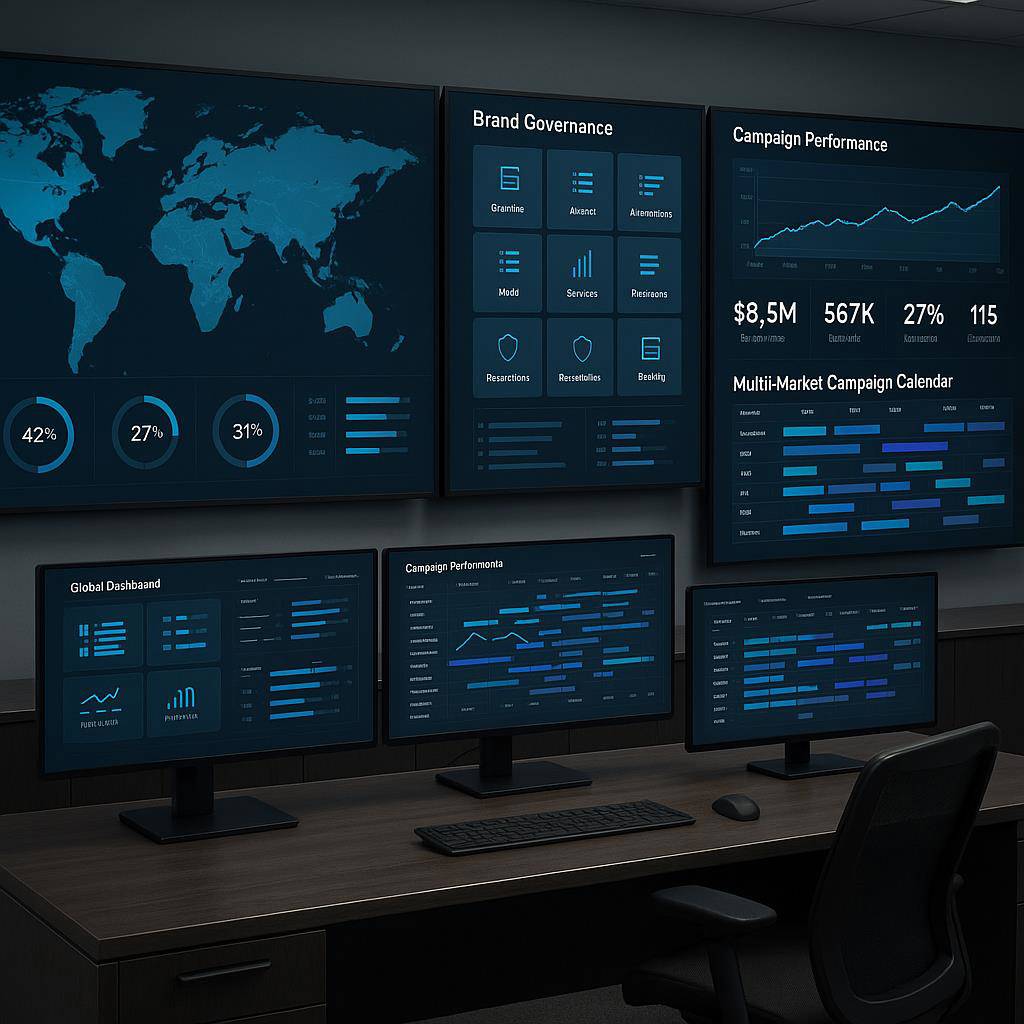
Scaling digital performance across complex enterprises
Enterprises don’t struggle with “marketing” so much as they struggle with marketing at scale. Multiple regions, product lines, brands, languages, and tools complicate everything from governance to attribution. The winning approach to enterprise digital marketing services is an operating system for growth—one that pairs clear decision rights with integrated data, standardized workflows, and relentless experimentation.
This guide distills a proven playbook for complex organizations. You’ll learn how to architect an enterprise-ready model that unifies CDP/CRM data, accelerates content and media execution across markets, enforces QA standards, and links every initiative to measurable OKRs. If you’re ready to replace chaos with clarity—and convert scale into a competitive advantage—read on.
Quick Summary: Governance, integrations, and performance ops
When enterprises achieve consistent marketing performance, it’s rarely a single channel win—it’s an orchestration win. Here’s the short version of the enterprise playbook:
- Governance first: Define decision rights, approvals, and compliance guardrails before scaling spend.
- Data unification: Connect CDP, CRM, eCommerce, analytics, and BI to one trusted source of truth.
- Global-local balance: Centralize strategy and guardrails; empower markets with localized assets and budgets.
- Performance operations: Run agile pods, shared playbooks, and QA gates that reduce rework and risk.
- Experimentation engine: Pipeline rapid tests tied to OKRs and resource capacity, not ad hoc ideas.
Throughout this guide, we’ll map each piece to tangible workflows and tools you can operationalize in weeks—not quarters.
Operating Model: In-house vs partner, pods, RACI, SLAs
Most enterprises thrive with a hybrid model: strategic core functions in-house and specialized capabilities via a partner network. The key is clarity. Define a RACI for each process (briefing, approvals, publishing, QA, reporting) and enforce it across teams and tools.
- Pods and squads: Organize cross-functional pods by region, product, or lifecycle stage (e.g., acquisition, activation, retention). Give pods a shared backlog, sprint cadence, and QA checklist.
- Service-level clarity: Set SLAs/SLOs for intake, creative turnaround, media ops, and data refreshes. Measure the marketing factory, not only the campaign.
- Partner orchestration: Maintain a central vendor register, shared playbooks, and a unified reporting layer so partners can plug in without adding friction.
As capabilities mature, rebalance in-house vs. partner ownership. Keep a lean core of brand, strategy, data governance, and platform ownership—and surround it with execution muscle that can flex with demand.
Data & Integrations: CDP/CRM, BI, privacy compliance
Enterprise growth relies on a connected data layer. Start with a stable identity framework and consent management, then create a bidirectional flow between your CDP, CRM, ecommerce, and ad platforms. Govern data contracts explicitly—what moves where, how often, and under what legal basis.
- Identity resolution: Match profiles with deterministic rules and enrich with first-party events. Avoid over-reliance on third-party IDs.
- Attribution and MMM: Pair multi-touch attribution for near-term optimization with MMM for budget planning and scenario testing.
- BI readiness: Land standardized events and UTM taxonomies in a warehouse, then expose curated views for marketing, sales, and finance in BI.
- Privacy by design: Enforce GDPR/CCPA consent states, retention policies, and role-based data access across tools.
Use a pragmatic roadmap: document your data model, stabilize event collection, standardize UTMs, and then scale use cases like lead scoring, churn prediction, and creative intelligence. If you’re exploring AI acceleration, align with AI Consulting to validate feasibility, governance, and model performance.
Global-Local: Playbooks, localization, QA standards
World-class enterprise marketing blends centralized brand control with local market authenticity. Codify this in playbooks that define what’s standardized (brand voice, components, data schema) versus what’s localized (copy, offers, channels).
- Localization workflow: Provide source assets, transcreation guidelines, and brand component libraries; automate handoffs and QA.
- Creative systems: Use modular design tokens and reusable blocks. Keep brand assets in a governed library with version control.
- Quality assurance: Enforce preflight checklists: legal, tracking, accessibility, language review, device/browser QA, and campaign taxonomy.
Build repeatable excellence: centralize strategy and tooling; empower markets for speed and cultural nuance. Upgrade your brand and asset kits with Branding Design and scalable Graphic Design systems that reduce cycle times and rework.
Performance Framework: OKRs, experimentation, QA gates
Tie strategy to outcomes with OKRs that cascade from corporate goals to regional and channel targets. Every initiative should map to a single Objective and a few measurable KRs, with weekly progress reviews and quarterly reset cycles.
- Experimentation pipeline: Central backlog with hypotheses, impact/effort scoring, and standard templates for design, QA, and analysis.
- QA gates: Pre-launch checks for tracking, consent, brand, localization, and performance budgets (page speed, CLS, LCP).
- Cadence: Weekly squad standups, monthly business reviews (MBR), and quarterly business reviews (QBR) anchored on KPIs.
Operationalize velocity with channel-specific playbooks. For paid media tests, leverage a structured framework with PPC Service. For organic growth sprints, bake in technical and on-page checklists from SEO Services. Validate landing page speed and UX with Website Development, and turn product pages into testing sandboxes using Ecommerce Management Services.
Change Management: Training, adoption, center of excellence
Technology doesn’t drive results—adoption does. Pair every platform or process rollout with enablement that meets teams where they are. Establish a Center of Excellence (CoE) to maintain playbooks, measure maturity, and guide partner onboarding.
- Role-based upskilling: Curate learning paths for channel managers, analysts, and content teams with certification checkpoints.
- CoE governance: Define charters, intake, prioritization, and KPIs (adoption rate, time to first value, audit scores).
- Communities of practice: Share test results, templates, and retros across markets to reduce duplicated effort.
Anchor change in outcomes—train on the job with current initiatives. For owned and earned execution lifts, cross-train teams on Digital Marketing Services, SMM Services, and Email Marketing Services; reinforce with responsible automation and governance from AI Consulting.
Recommended Partner: Enterprise Digital Marketing Services by TMAT Network
If you need an experienced partner to architect and operationalize this model, explore Enterprise Digital Marketing Services by TMAT Network. TMAT builds enterprise-ready growth systems that blend governance, integrations, and agile execution across regions and business units.
- Operating model design: RACI, SLAs/SLOs, intake, and agile pod structures suited to complex orgs.
- Data architecture: CDP/CRM integration, consent management, BI pipelines, and attribution.
- Global-local acceleration: Playbooks, localization workflows, and QA standards that scale.
- Performance engine: OKR design, experimentation frameworks, MBR/QBR rhythms, and executive dashboards.
- Channel centers: Execution lifts across PPC, SEO, Social, Email, and Web.
For vertical-specific acceleration, TMAT offers tailored solutions for B2B Digital Marketing, SaaS growth, Technology brands, Ecommerce, and Retail.
Conclusion: Operationalize excellence — schedule an enterprise readiness review
Enterprises win by operationalizing excellence—consistent governance, integrated data, and a test-and-learn culture rooted in measurable OKRs. With the right operating model, your teams launch faster, localize smarter, and convert more efficiently across every market.
Ready to assess your maturity and prioritize the next 90 days? Schedule an enterprise readiness review with TMAT Network’s Enterprise Digital Marketing Services. Align leadership, tools, and teams around a single operating system for sustainable growth.
FAQ: Vendor onboarding? Data governance? Localization? Tool standardization? Reporting cadence?
How should we structure vendor onboarding at enterprise scale?
- Create a single vendor registry with scopes, SLAs, security posture, and data access levels.
- Provide standardized kickoff decks, playbooks, taxonomies, and analytics requirements.
- Assign a pod owner and integrate vendors into existing sprints and QA gates—no parallel processes.
What does strong data governance look like for marketing?
- Document data domains, owners, and quality thresholds (freshness, completeness, uniqueness).
- Enforce consent states and retention policies across CDP/CRM and downstream channels.
- Maintain a marketing data catalog (events, UTMs, dimensions) and change logs for version control.
Best practices for localization without losing the brand?
- Centralize brand tokens and component libraries; localize copy, offers, and channels.
- Use transcreation guidelines and linguistic QA; test for cultural fit and compliance.
- Roll out regional experimentation backlogs and share winners globally via the CoE.
How do we standardize tools across regions?
- Define the “golden path” stack by use case (media ops, content ops, analytics, consent).
- Set minimum standards for integrations, SSO, observability, and auditability.
- Gate new tool requests through a CoE intake with business case, integration plan, and sunset criteria.
What reporting cadence works for global teams?
- Weekly squad standups for execution KPIs; monthly business reviews (MBR) for trend analysis.
- Quarterly business reviews (QBR) for strategy, budget reallocation, and roadmap resets.
- Executive scorecards with leading indicators (velocity, QA pass rate) and lagging KPIs (pipeline, revenue).
For execution support and enterprise-grade governance, partner with TMAT Network. Complement your stack with focused capabilities like SEO Services, PPC, Social, and Email.
Comments are closed