
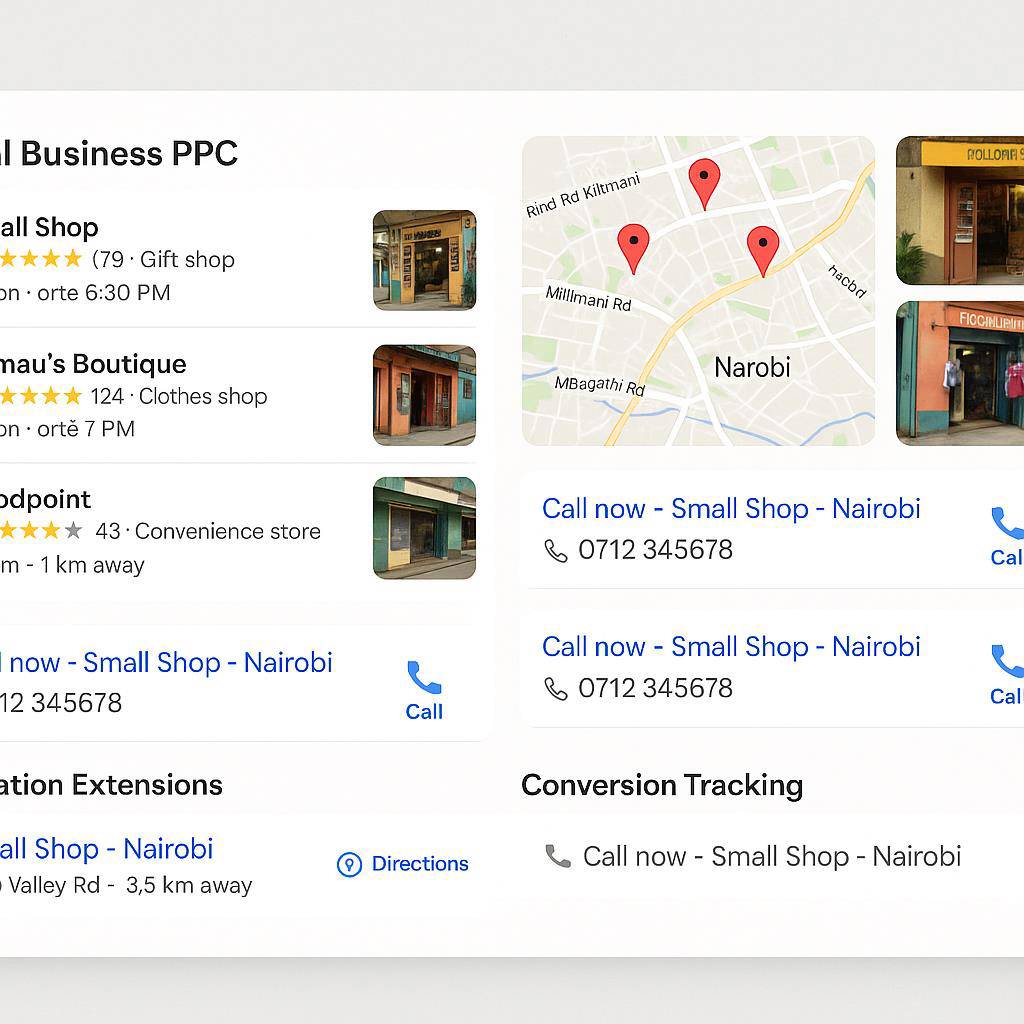
Turn Local Intent Into Calls and Foot Traffic With PPC
Your next customer is two blocks away, searching on a phone, ready to buy. A focused PPC program turns that local intent into phone calls, booked appointments, and foot traffic. With precise geo-targeting, call-focused ads, and conversion-optimized landing pages, you can show up at the exact moment your neighbors need you.
If you’re comparing options for a PPC agency for local businesses, look for a partner that builds campaigns around calls, speed, and measurable revenue. The right setup prioritizes map visibility, location extensions, fast click-to-call, and campaign structures that protect your budget from junk traffic.
Local PPC pairs perfectly with complementary channels. Strengthen your foundation with SEO Services and ensure a fast, conversion-ready site with Website Development or Web Design Development. When each piece supports the next, you win more of the “near me” demand at a lower cost.
Local PPC in a Nutshell: What to Expect
A high-performing local PPC program is built to capture high-intent searches fast. It emphasizes service keywords, phone conversions, and local trust signals that reduce friction.
- Channels: Google Search, Bing Search, and map inventory via location extensions.
- Targets: Radius and ZIP codes with exclusions to cut waste outside your market.
- Ad Formats: Responsive search ads, call-only ads, and extensions that boost phone calls.
- Funnels: Call-first landing pages with prominent click-to-call and instant directions.
- Measurement: Dynamic call tracking, form quality scoring, and revenue alignment.
Expect early signal within days, initial calls in 1–2 weeks, and stable performance in 30–45 days depending on budget and competition. Local service providers often see meaningful results sooner when campaigns prioritize call intent over broad traffic. For broader growth, consider integrated Digital Marketing Services and SMM Services to expand branded demand.
Precision Local Targeting: Radius, ZIPs, Maps, Extensions
Local PPC wins and loses on geography. Every dollar should be spent where your best customers live, work, and search. Use a layered approach to coverage and cost control.
- Radius targeting: Start with 3–10 miles around your location, adjusting for drive-time, density, and competition. Create separate rings for core vs. expansion zones to fine-tune bids.
- ZIP code targeting: Add or exclude ZIPs for precision. Prioritize high-value neighborhoods and remove low-yield areas based on call quality and close rates.
- Presence only: In Google Ads, choose Presence: People in or regularly in your targeted locations to avoid “interest” bleed from tourists or out-of-area searches.
- Location extensions: Connect your Google Business Profile to trigger map pins, distance indicators, and click-to-call right from ads.
- Dayparting & devices: Bid up during business hours and on mobile, when callers convert fastest. Reduce or pause overnight unless you truly serve 24/7 demand.
For businesses with multiple branches, group campaigns by location and leverage unique ad copy, phone numbers, and landing pages per storefront. If you’re in specialized industries, review tailored plays like Plumbing Digital Marketing or Dentist Digital Marketing Services to align geo strategy with service lines.
Ad Strategy That Drives Calls
Local intent demands clarity. Your ads should immediately answer who you are, what you do, where you serve, and how to call. Prioritize call-focused formats and strong, action-led copy.
- Keywords with service intent: “[service] near me,” “[service] in [city],” emergency/24-7 terms, and brand + service combinations. Build SKAG or tight ad groups for precision.
- Responsive search ads: Pin essential value props and inject dynamic city names for relevance without over-automation.
- Call-only ads: Great during peak hours. Make the CTA unmistakable: Tap to Speak With a Tech Now, Immediate Booking, Free Estimate by Phone.
- Extensions: Use call, location, structured snippets (Services), price extensions (packages), and sitelinks (Financing, Reviews, Directions).
- Message match: Mirror ad promises on the landing page. If the ad says “Same-Day Service in 2 Hours,” the first screen should prove it.
Competitive neighborhoods can justify selective conquesting. If you use this tactic, cap bids, use negative keywords, and route traffic to comparison pages. For vertical-specific tactics, see Moving Company Digital Marketing and Retail Digital Marketing Services.
Landing Pages That Convert Walk-Ins and Calls
Your ads buy attention. Your landing page converts it. Every element should lower anxiety and speed the path to a call or visit.
- Above the fold clarity: Headline = service + city, subhead = value prop, and a big click-to-call button that stays sticky on mobile.
- Local trust signals: Google rating stars, review snippets, “serving [neighborhoods]” list, local photos, and a map embed with parking info.
- Proof and policies: Licenses, insurance, guarantees, emergency availability, and transparent pricing or “from” ranges.
- Frictionless forms: 3–4 fields max with smart auto-fill. Offer call-back windows to replace voicemail ping-pong.
- Speed + accessibility: Sub-2s mobile load, big tap targets, and readable contrast. Use dynamic number insertion (DNI) for accurate call attribution.
If you need fast, conversion-safe builds, explore Website Development and E-commerce Website (for local retail). For visual impact, pair with Branding Design or Graphic Design to keep creative on-brand.
Measurement That Matters: Calls, Quality, Revenue
Clicks don’t pay rent. Calls, booked jobs, and revenue do. Build tracking that goes beyond CPC to lead quality and sales impact.
- Dynamic call tracking (DNI): Swap numbers by source, campaign, and keyword. Capture duration, first-time caller, device, and recording for QA.
- Quality scoring: Tag calls as good, spam, or not a fit. Score forms by completeness, job size, or service line for better bidding signals.
- Revenue alignment: Push closed-won revenue or job values back to ad platforms via Offline Conversion Import. Adjust bids by profit, not just leads.
- UTMs + CRM: Pass campaign data into your CRM to report by channel, ad group, and keyword. Build a feedback loop with sales.
- Exclusion hygiene: Block spam sources, add negative keywords, and exclude low-value ZIPs as you learn.
Integrations and automation can tighten this loop. If you’re exploring advanced workflows, AI Consulting can help structure data flows and predictive bidding that favors higher-margin calls.
Budget Playbook: Start, Scale, and Seasonal Tactics
Spend where it matters most and scale with proof. A disciplined budget framework keeps you aggressive on winners and cautious on experiments.
- Start: Allocate 70% to core service campaigns, 20% to near-me/emergency, 10% to tests. Typical local starts range from $50–$150/day depending on market size.
- Scale: Increase budgets when CPA is within goal or call quality is strong. Use impression share (lost to budget) and eligible search volume to justify lifts.
- Protect ROAS: Cap bids in fringe ZIPs and during low-converting hours. Shift budget to mobile and “open now” windows.
- Seasonality: Pre-boost 2–4 weeks before peak (e.g., HVAC, moving, tax season). Spin up tailored ad copy and landing sections for seasonal pain points.
- Portfolio view: Balance brand, service, emergency, and competitor campaigns. Pause or throttle segments that drift below quality benchmarks.
Need broader growth initiatives while PPC ramps? Consider Small Business Digital Marketing or niche support like Education Digital Marketing Services and Real Estate Digital Marketing Services if you operate in those spaces.
Recommended Partner: PPC Service by TMAT Network
If you want a PPC agency for local businesses that moves fast and measures what matters, the PPC Service by TMAT Network is built for local-first success. Setup includes intent-focused structures, geo-segmentation, call-only variants, and rigorous A/B testing to lift conversion rates responsibly.
- Local-friendly setup: Radius and ZIP frameworks, location extensions, and call tracking aligned to your storefronts.
- Channel coverage: Google, Bing, and social ads, with budgets calibrated from lean pilots up to scalable programs.
- Conversion-first design: Landing page guidance for sticky click-to-call, review proof, and map embeds to drive visits.
- Revenue alignment: Form and call quality scoring plus offline conversion import for smarter bidding.
Round out your stack with SEO Services, Email Marketing Services, and Ecommerce Management Services if you operate curbside or click-and-collect. Multi-channel synergy helps you capture both urgent and future demand.
Make the Phone Ring Reliably — Book a Local PPC Audit
Local PPC should feel dependable: steady calls during business hours, fewer junk leads, and visible ROI. If your campaigns are noisy or inconsistent, a structured audit can clear the clutter and focus spend on what truly converts.
Get a plan that sharpens geo coverage, simplifies keyword intent, tightens ad messaging, and upgrades your landing experience. Start by requesting a review from TMAT Network’s PPC Service. In one engagement, you can move from guesswork to a repeatable call engine designed around your neighborhood, your phones, and your margins.
Local PPC FAQ
Budget to start?
Most local service providers start between $50–$150/day. Dense or highly competitive metros may require more. Begin lean, prove CPA/lead quality, then scale.
How to avoid junk leads?
Tighten match types, add negatives weekly, restrict to “Presence” location setting, use call-only during peak hours, and route calls with IVR to filter spam. Score calls and exclude low-quality sources.
Can we geo-fence?
Yes. Use radius or ZIP targeting for most needs. For precise borders (events, campuses, trade areas), layer radius rings and exclusions or deploy polygon-style boundaries where available. Always validate with location reports.
How fast to see calls?
With proven keywords and call-only formats, many accounts see first calls within days and stable pacing in 30–45 days. Season, budget, and competition can lengthen timelines.
Call tracking setup?
Implement dynamic number insertion (DNI) on landing pages, connect to Google Ads for call conversions, record and tag quality, then import qualified outcomes and revenue to optimize bids. If you need help, the TMAT Network PPC team can configure end-to-end tracking.
Exploring industry-specific programs? Review additional options like Accountant Digital Marketing, Automotive Digital Marketing Services, and SaaS Digital Marketing Agency for niche insights.
Comments are closed