
AEO vs SEO vs GEO: The Marketing Differences That Matter in 2026
Too many teams chase every shiny tactic and stall. The smarter move is to pick the channel that matches your growth goal, then sequence the rest. This guide cuts through the jargon and explains the real-world AEO vs SEO vs GEO marketing differences so you can invest with confidence.
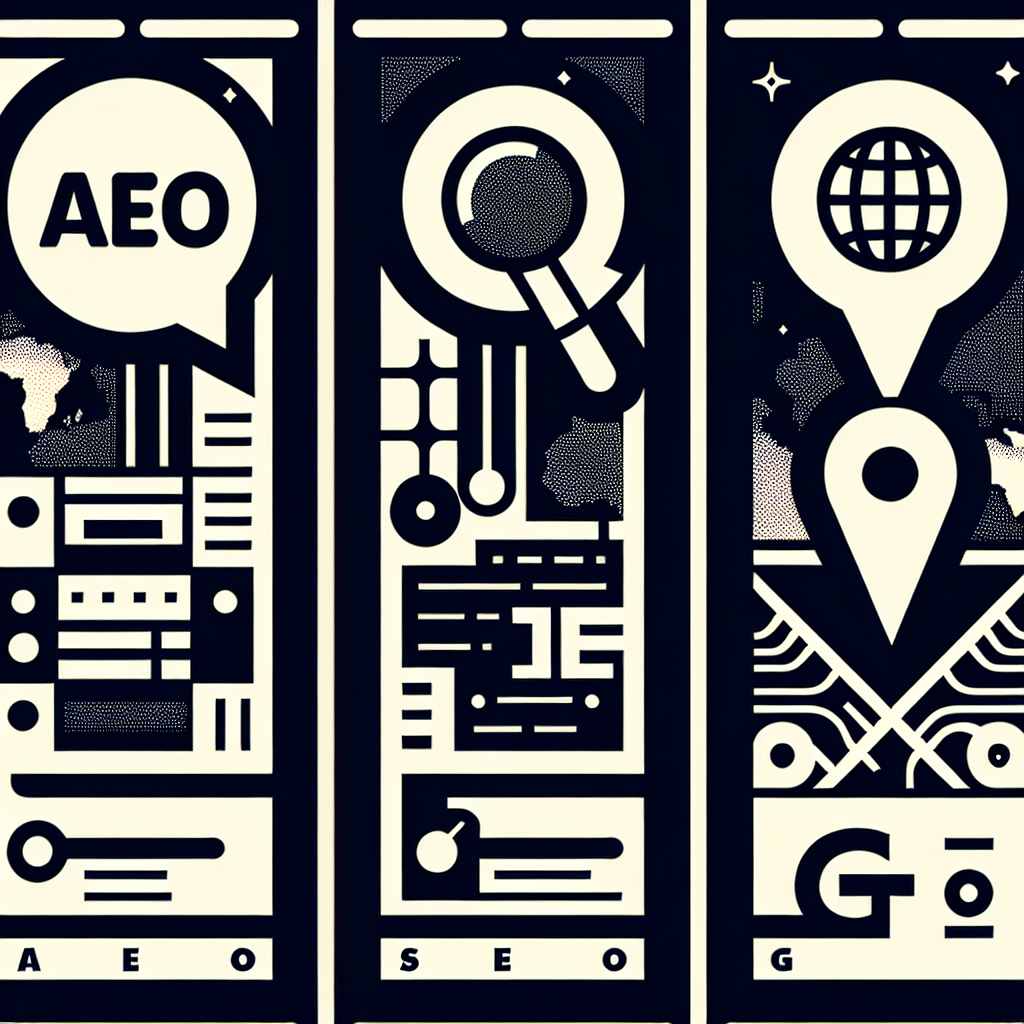
Here’s how we define the three pillars in 2026. AEO (Answer Engine Optimization) earns visibility in AI Overviews, featured snippets, People Also Ask, voice assistants, and answer-first surfaces. SEO (Search Engine Optimization) grows rankings and traffic across traditional organic results. GEO (Geographic/Local SEO) captures local intent within map packs, Google Business Profile (GBP), Apple Maps, and location pages.
They’re complementary—yet different enough that your content, schema, KPIs, and timelines should change by tactic. Use this playbook to decide which to lead with, how to budget 30/60/90 days, and where AI shifts the ground in 2026.
For background, see SEO on Wikipedia, Google’s SEO Starter Guide, and Schema.org for structured data.
Quick Summary: When to Use AEO, SEO, and GEO
- Use AEO when buyers ask lots of questions and you can win zero-click visibility. Ideal for SaaS, education, and info-first brands that need fast authority in AI Overviews, featured snippets, and PAA.
- Use SEO when you need compounding traffic across the funnel. Best for content-first sites, product/category expansion, and competitive terms where topic clusters and internal links shine.
- Use GEO when proximity and local intent drive revenue. Perfect for local and multi-location businesses that rely on GBP calls, directions, and map pack dominance.
If you sell software or complex services, AEO-led with SEO support is a strong start. If you run a content-heavy site, lead with SEO. If you operate physical locations or service areas, lead with GEO—and layer AEO answers for near-me questions.
Side-by-Side Comparison: Goals, Channels, Timelines, and KPIs
Primary goal
- AEO: Be cited or surfaced as the best short answer across AI Overviews, featured snippets, PAA, voice assistants, and answer-first engines.
- SEO: Rank consistently across core keywords, grow non-brand sessions, and increase high-intent conversions.
- GEO: Dominate local map packs, drive calls and directions from GBP, and convert local queries into store visits or bookings.
Core channels and surfaces
- AEO: Google AI Overviews, featured snippets, PAA, knowledge panels, YouTube chapters, voice search.
- SEO: Organic web results, sitelinks, image/video carousels, news/discover when relevant.
- GEO: Google Business Profile, Google Maps, Apple Maps, local directories, location and city/service pages.
Content formats that win
- AEO: FAQ hubs, checklists, definitional explainers, how-tos, comparisons, concise answers with citations.
- SEO: Pillar pages and topic clusters, in-depth guides, product/category pages, comparison and alternative pages.
- GEO: Robust location pages, city-specific service pages, localized blog posts, GBP posts and Q&A.
Technical signals
- AEO: FAQPage, HowTo, QAPage, Speakable schema; entity linking; clean headings; authoritative citations. See Schema.org.
- SEO: Core Web Vitals, crawlability, internal linking, canonicalization, structured data for Article/Product/Organization.
- GEO: LocalBusiness schema, NAP consistency, reviews, citations, GBP categories, photos, and attributes. See GBP Help.
Typical timeline to traction
- AEO: 2–8 weeks for first citations/snippets if you ship focused answer content with proper schema.
- SEO: 3–6+ months for compounding growth, faster for low-competition long-tails.
- GEO: 2–12 weeks depending on competition, reviews, and NAP/citation cleanup.
KPIs that matter
- AEO: Featured snippet share, PAA coverage, AI Overview citations, zero-click impressions, assist conversions.
- SEO: Non-brand organic sessions, keyword rankings, engaged sessions, assisted and last-click conversions, revenue.
- GEO: Map pack rankings, GBP views, calls, messages, direction requests, local conversions.
For a deeper dive on content clusters and topic authority, HubSpot’s primer on topic clusters is useful. For local strategy fundamentals, see BrightLocal’s What Is Local SEO? and Wikipedia’s overview of featured snippets.
Best-Fit Use Cases by Business Model
SaaS and information-dense brands (AEO-led)
Buyers ask “how” and “why” before “buy.” Answer-first content, authoritative citations, and clean schema put you in the conversation early. Stack AEO with SEO for mid-funnel education and conversion pages.
- Great fit for: product-led SaaS, analytics tools, learning platforms, and complex B2B.
- Recommended plays: FAQ hubs, comparison pages (vs alternatives), how-to guides, definitional clusters.
- Explore our SaaS Digital Marketing and Education Digital Marketing solutions for blueprint examples.
Content-first and editorial sites (SEO-led)
When growth hinges on breadth and depth of ranking pages, SEO fundamentals plus topic clusters are king. Structure pillars and internal links to consolidate authority, then harvest long-tail demand.
- Great fit for: technology, enterprise, and category publishers.
- Recommended plays: pillar pages, hub-and-spoke clusters, evergreen guides, programmatic long-tail where quality holds.
- See our Technology Digital Marketing and Enterprise Digital Marketing offerings.
Local and multi-location brands (GEO-led)
If your revenue depends on proximity, local reputation, and service availability, prioritize GEO. Optimize GBP, build robust location pages, and maintain NAP and reviews.
- Great fit for: hospitality, home services, retail, real estate, fitness, legal, and healthcare insurance.
- Recommended plays: GBP optimization, review generation, location and city-service pages, localized content and offers.
- Relevant services: Hotel, Plumbing, Retail, Real Estate, Fitness & Nutrition, Law, Insurance, Small Business.
Budget and Timeline: 30/60/90-Day Plans
Budget allocations vary by scope, but percentages help you plan intelligently. Below are example 30/60/90-day splits you can scale up or down.
AEO-led plan (SaaS/info brands)
Day 0–30 (Foundation) — 40% of quarter budget
- Research: question mining from SERPs, PAA, community forums, sales calls (10%).
- Information architecture for FAQ hubs and comparison clusters (10%).
- Schema and templates: FAQPage, HowTo, Speakable, organizational schema (10%).
- Technical: Core Web Vitals, crawl budget cleanup (10%).
Day 31–60 (Production) — 35%
- Ship 8–12 answer-first pages with concise intros, scannable headings, and citations (15%).
- Video/shorts for YouTube chapters and speakable snippets (10%).
- Digital PR for expert quotes and high-authority references (10%).
Day 61–90 (Optimization) — 25%
- Snippet testing: headings, summary boxes, schema refinements (10%).
- Expand long-tail “how-to” and “vs” queries (10%).
- Attribution: track zero-click assists and pipeline influence (5%).
SEO-led plan (content-first sites)
Day 0–30 — 35%
- Technical audit, internal linking model, canonical strategy (15%).
- Topic cluster mapping and editorial calendar (10%).
- Content briefs with E-E-A-T elements and schema (10%).
Day 31–60 — 40%
- Publish 6–10 pillar/spoke assets, refresh top 10 decaying pages (20%).
- Link earning via source-worthy data and partnerships (10%).
- Improve UX patterns for dwell and engagement (10%).
Day 61–90 — 25%
- Pruning and consolidation to avoid cannibalization (10%).
- Programmatic long-tail where quality holds (10%).
- Scale internal links; build comparison and alternatives pages (5%).
GEO-led plan (local and multi-location)
Day 0–30 — 40%
- GBP audit and optimization: categories, services, photos, Q&A (15%).
- NAP cleanup and citation building (10%).
- Location page templates with LocalBusiness schema (10%).
- Review generation system and playbooks (5%).
Day 31–60 — 35%
- Publish city/service pages with unique proof (photos, team, case studies) (15%).
- Local link building and partnerships (10%).
- GBP posts, offers, events (10%).
Day 61–90 — 25%
- Expand nearby suburbs/towns pages (10%).
- Track calls, directions, and on-page conversions; iterate (10%).
- Seasonal promos and event tie-ins (5%).
If you operate in verticals like Events, Tourism, or Government, tailor calendar cycles and compliance steps accordingly.
Common Mistakes to Avoid
- Overlapping content and cannibalization: Multiple pages answering the same query dilute authority. Consolidate, redirect, and use clear internal linking.
- Thin local pages: City pages that swap a city name and nothing else won’t rank. Add unique staff info, local reviews, photos, inventory/services, and case studies.
- Ignoring structured data: AEO and GEO both rely on machine-readable context. Add FAQPage/HowTo/QAPage and LocalBusiness schema where relevant.
- GBP neglect: In GEO, outdated categories, few photos, and slow responses crush visibility. Maintain GBP weekly with posts and Q&A.
- Measuring only rank: Track zero-click assists (AEO), engaged sessions and revenue (SEO), and calls/directions (GEO). Different tactics, different KPIs.
- Over-indexing on automation: Programmatic content must meet quality bars. Human review and proof elements are mandatory.
For quality guidelines, review Google’s documentation and the principles behind E-E-A-T in the Creating helpful content guide.
Affiliate Integration: Book a Strategy Consultation
Unsure how to blend AEO, SEO, and GEO for your goals? Book a no-pressure strategy consultation with TmatNetwork. We’ll scope a 30/60/90 plan, budget ranges, and quick wins you can execute immediately.
- Follow us on Instagram for playbooks and case studies.
- Connect on LinkedIn (Company) or with our founder’s personal profile.
- Creative production partner: TblaqHustle for content and campaign assets.
Industry solutions you can benchmark today: Entertainment, Logistics, Wealth Management, Manufacturing, and Luxury.
Conclusion: Pick a Lead Horse, Then Sequence the Rest
You rarely need everything at once. Pick the tactic that best matches your revenue motion, then sequence the others for compounding gains. AEO wins fast authority for question-heavy journeys. SEO builds durable traffic across the funnel. GEO converts local intent into calls, directions, and visits.
Decide your lead horse, pressure-test it with a 90-day plan, and hold it to the right KPIs. Layer the other two as supporting channels when traction appears. That’s how you turn channel clarity into predictable growth.
Ready to build your plan? Book a strategy consult with TmatNetwork and get a roadmap aligned to your goals.
FAQ: Can a single campaign cover AEO, SEO, and GEO?
Yes—with a lead tactic. Build one integrated plan where a primary channel sets the pace and the other two reinforce outcomes. For example, an AEO-led campaign can publish answer hubs that also feed SEO pillars. Those same pages can link to localized service areas to support GEO.
Operationally, maintain one content calendar, one design system, and shared schema templates. Track separate KPIs per channel so you don’t misread progress. In most cases, 60–70% of resources go to the lead channel while 30–40% maintain the supporting tracks.
FAQ: What’s the fastest path to results?
In most scenarios, AEO and GEO offer the fastest early wins. Target direct questions, definitions, and how-tos that can earn snippets and AI Overview citations. In parallel, optimize GBP and publish high-quality location pages to unlock calls and directions.
SEO’s compounding effect is the most durable, but it usually takes longer to show big gains. Blend quick-win AEO/GEO with SEO fundamentals so momentum arrives early without sacrificing long-term scale.
FAQ: How does AI change this comparison in 2026?
AI elevates answer surfaces and summary experiences, increasing zero-click outcomes. AEO becomes central: concise, sourced, and structured answers that models can quote. Entities, citations, and schema clarity matter more than ever.
SEO shifts from pure rank-chasing to earning inclusion in AI-generated contexts and modules like AI Overviews. High-quality sources with clear E-E-A-T and first-party data rise. GEO still hinges on proximity and reputation, but AI can summarize reviews, highlight attributes, and surface niche providers faster.
Action items: use structured data, cite authoritative sources, show proof (case studies, screenshots, policies), and measure assisted impact from zero-click impressions. Keep an eye on Google’s updates (see AI Overviews) to adjust templates.
FAQ: Do I need schema for all three?
Yes—schema accelerates understanding for both search engines and AI systems. For AEO, prioritize FAQPage, HowTo, QAPage, and Speakable. For SEO, implement Article, Product, Organization, WebSite, and BreadcrumbList. For GEO, use LocalBusiness, Service, GeoCoordinates, and AggregateRating.
Ensure your schema reflects real on-page content and business facts. Consistency across pages, GBP, and citations prevents trust issues. Reference Schema.org for properties and examples.
Contact Us
Speak to the team at TmatNetwork to scope your AEO, SEO, and GEO mix.
- Website: https://tmatnetwork.com
- Instagram: @tmatnetwork
- LinkedIn (Company): TmatNetwork
Explore industry-specific roadmaps: Fashion, Interior Design, Technology, Recruitment, and Real Estate.


 Quick Response