
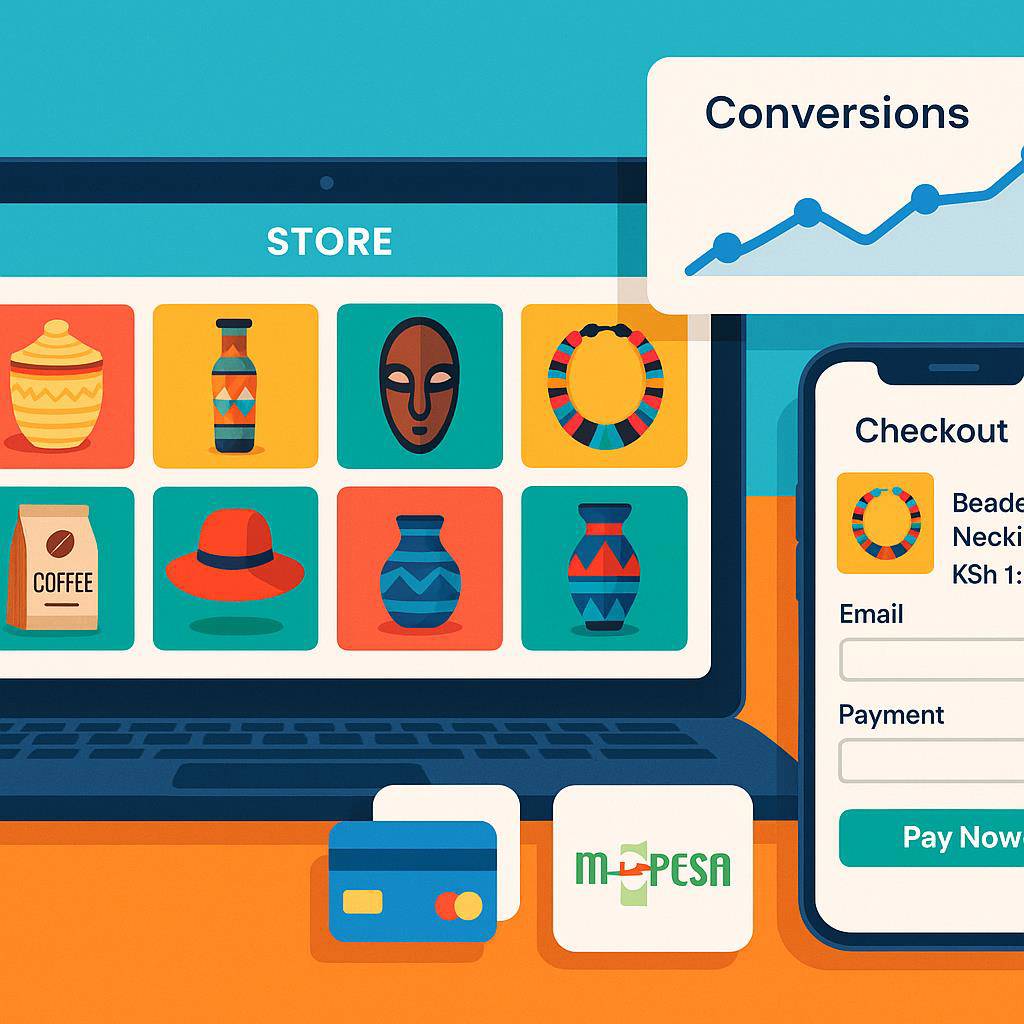
Launch and scale an online store built for Kenya’s buyer
Kenya’s ecommerce boom is shifting from experimental to enterprise-grade. By 2026, the winning online stores will be built for a mobile-first buyer, optimized for M-Pesa checkout, lightning-fast on 3G/4G, trustworthy at every step, and discoverable across Google, TikTok, and social commerce. If you’re planning ecommerce website development in Kenya, now is the time to build a platform that scales with demand, protects margins, and turns first-time shoppers into loyal customers.
This guide distills the decisions that matter: the right platform, a future-proof tech stack, Core Web Vitals, M-Pesa integration, logistics, analytics, and growth loops. It’s designed for founders, CMOs, and operations leads who want clarity, not clutter so you can launch quickly and grow sustainably.
Looking for a partner? Explore E-commerce Website Development by TMAT Network for a streamlined launch, from product listings and payments to SEO and analytics.
Quick Summary: Platforms, features, timelines, and costs
What you need to know at a glance
- Best-fit platforms: Shopify for speed-to-market and reliability; WooCommerce for deeper control and content; Headless for performance at scale and custom experiences.
- Must-have features: Fast PDPs, secure localized checkout, M-Pesa STK push and paybill integration, smart search, UGC/reviews, inventory sync, and robust analytics.
- Timelines: Shopify (4–8 weeks), WooCommerce (6–10 weeks), Headless (10–16+ weeks) depending on scope, integrations, and content readiness.
- Indicative budgets (one-off): Shopify KES 350k–1.2m; WooCommerce KES 500k–1.8m; Headless KES 1.2m–3.5m+. Monthly ops: KES 30k–250k for maintenance, content, CRO, and ads tracking.
- Security & compliance: PCI-DSS compliant gateways, SSL/TLS, and Kenya’s Data Protection Act (consent, privacy notices, secure data handling).
Want a faster path? Start with Website Development and expand with Ecommerce Management Services once you’re live.
Essential Features: Fast PDPs, secure checkout, M-Pesa/payments, search, reviews
Speed, trust, and convenience drive conversions
Product pages are where revenue is won or lost. Build PDPs that load in under 2 seconds on mid-tier Android devices. Preload hero images, lazy-load secondary media, and prioritize visible content for a clean LCP.
- Payments: Offer M-Pesa via providers like DPO, PesaPal, or iPay Africa. Support STK push, paybill, tills, and cards (Visa/Mastercard). Present fees and delivery costs clearly to reduce checkout anxiety.
- Checkout UX: Fewer steps, auto-complete addresses, mobile-friendly forms, guest checkout, and one-tap reorders for returning buyers.
- Search & discovery: Typo tolerance, synonym mapping (e.g., “kitambo” vs. “vintage”), filters, and merchandising rules to highlight margin-positive SKUs.
- UGC & reviews: Display verified reviews, Q&A, and user galleries. Incentivize photo/video reviews and moderate them to maintain trust.
- Trust signals: SSL badges, clear return policies, delivery SLAs for Nairobi/Mombasa/Kisumu, and visible customer support (WhatsApp, live chat, or phone).
Deepen user experience with UI/UX Design that respects Kenyan browsing habits and data costs.
Tech Stack: Shopify/WooCommerce, headless, PIM, CDNs
Choose a flexible foundation that scales
The right stack aligns with your catalog complexity, customization needs, and growth targets. Keep architecture modular and integration-first.
- Shopify: Best for speed-to-market, reliability, and app ecosystem. Consider Hydrogen/Oxygen for headless builds and built-in CDN for global caching.
- WooCommerce: Ideal for content-heavy brands and custom workflows. Pair with WP Engine/Kinsta and enable object caching and optimized media delivery.
- Headless commerce: Next.js/Remix front end, Shopify or Woo back end, and GraphQL APIs for blazing performance, flexibility, and multi-channel expansion.
- PIM: Centralize data with Akeneo or Plytix to manage attributes, translations, images, and channel-specific titles. This prevents PDP inconsistency at scale.
- CDN: Cloudflare, Fastly, or Akamai for asset optimization, image resizing, and edge caching across the region.
As you scope ecommerce website development in Kenya, map integrations for M-Pesa, shipping, tax, ERP, and marketing automation early to avoid rework later.
SEO & CRO Foundations: Structured data, Core Web Vitals, A/B testing
Own demand with technical SEO and iterate with experiments
Organic traffic compounds. Bake SEO into your build, then continuously optimize for conversions using data and experimentation.
- Technical SEO: Implement Product, Offer, Breadcrumb, and Organization schema. Use clean URLs, XML sitemaps, and hreflang if targeting multiple regions.
- Core Web Vitals: Track LCP, INP, and CLS with performance budgets. Compress images (WebP/AVIF), preconnect to critical resources, and minimize render-blocking JS.
- Content strategy: Create category hubs, buying guides, and localized content (e.g., sizing in CM, local delivery times). Link internally between guides and PDPs.
- CRO: Run A/B tests on hero images, price displays, badges (express delivery), and free-shipping thresholds. Tools: VWO, Optimizely, Convert, or native app experiments.
Power growth with SEO Services and complement with Digital Marketing Services for multi-channel coverage.
Logistics & Ops: Inventory, shipping, returns, local taxes
Operational excellence protects margins and trust
Kenyan shoppers value accurate ETAs and clear return policies. Operations must sync across inventory, shipping, and tax to deliver reliably.
- Inventory sync: Real-time stock updates to prevent overselling. Use safety stock and back-in-stock alerts to recapture demand.
- Shipping: Integrate with local couriers (e.g., G4S, Fargo, Sendy, DHL eCommerce). Offer pickup points and scheduled delivery windows where possible.
- Returns: Publish an easy-to-follow policy (window, condition, refund method). Streamline RMAs and automate labels for faster resolutions.
- Taxes & compliance: Configure VAT rules accurately and generate compliant invoices. Align with KRA requirements and keep audit-ready records.
- Customer service: WhatsApp support, call-back options, and quick SLAs for high-value carts.
If you need steady hands post-launch, consider Ecommerce Management Services for updates, campaigns, and reporting.
Analytics & Growth: Funnels, LTV, lifecycle email/SMS
Measure what matters and create compounding loops
Move beyond vanity metrics. Track funnels, optimize CAC vs. LTV, and automate lifecycle touchpoints.
- Analytics stack: GA4, server-side tagging with GTM, Meta and TikTok Pixels, and consent management aligned to Kenya’s DPA. Build granular events for PDP views, add-to-cart, checkout steps, and refund events.
- LTV & cohorts: Analyze 30/60/90-day repeat rates, categories that drive second purchases, and discount elasticity. Tie cohorts to campaigns for budget reallocation.
- Lifecycle marketing: Email and SMS flows for welcome, browse abandonment, cart recovery, post-purchase care, replenishment, and win-backs. Consider Klaviyo/Omnisend and SMS via trusted providers.
- Attribution: Use UTM rigor, MMM-lite for strategic insights, and holdout tests to validate channels.
Accelerate programs with Email Marketing Services and performance media via PPC Service.
Recommended Partner: E-commerce Website Development by TMAT Network — listings, payments, SEO
Build with specialists who understand the Kenyan market
TMAT Network launches high-performing stores tailored to Kenya’s market realities: M-Pesa-first checkout, fast mobile UX, local shipping, and SEO that ranks. From product listings to analytics, you get a battle-tested process and a roadmap to scale.
- What you get: Strategic planning, platform setup (Shopify/Woo/Headless), M-Pesa integrations, UX/UI, performance tuning, and search-optimized content structures.
- Why it works: A delivery framework that prioritizes speed-to-value, clean data, and conversion science.
Explore the offer: E-commerce Website Development by TMAT Network. Pair it with SEO Services and Digital Marketing Services to compound growth.
Related services (sponsored): Retail Digital Marketing Services, PPC Service, Email Marketing Services, AI Consulting.
Conclusion: Build it right once — request an eCommerce blueprint
Your blueprint for a resilient 2026 storefront
The Kenyan ecommerce winner in 2026 won’t be the flashiest—it will be the most reliable. Fast PDPs, M-Pesa-first checkout, operational clarity, and a testing culture will outperform ad hoc tactics every time.
If you’re serious about ecommerce website development in Kenya, start with a blueprint: platform recommendation, UX flows, integration plan, SEO/CRO checklist, content map, and a realistic timeline and budget.
Next step: Request your blueprint via TMAT Network’s E-commerce Website Development. Launch confidently and scale with data.
FAQ: Shopify vs Woo? How long to launch? How to handle M-Pesa? Average budget? How to improve conversion rates?
Your top questions, answered
1) Shopify or WooCommerce—what’s better for Kenya?
Shopify wins on reliability, speed-to-market, and total cost of ownership when you need to move fast with robust apps. WooCommerce is better when you need deep content control, custom logic, or WordPress synergies. If you expect heavy customization and want edge performance, consider headless with Shopify or Woo as the commerce engine.
2) How long will it take to launch?
Typical timelines: Shopify 4–8 weeks, WooCommerce 6–10 weeks, and Headless 10–16+ weeks. Content readiness, product data quality, and integrations (M-Pesa, shipping, ERP, PIM) are the biggest timeline drivers.
3) How do we integrate M-Pesa?
Use vetted providers (e.g., DPO, PesaPal, iPay Africa) for STK push, paybill/till, and reconciliation. In Shopify, install an approved gateway app; in WooCommerce, use well-maintained payment plugins. Make sure to test edge cases: failed STK, partial payments, chargebacks, and refunds.
4) What’s the average budget for ecommerce website development in Kenya?
For a professional build: Shopify KES 350k–1.2m; WooCommerce KES 500k–1.8m; Headless KES 1.2m–3.5m+. Ongoing ops (hosting, content, CRO, analytics, and minor dev) can run KES 30k–250k per month depending on growth stage.
5) How do we improve conversion rates?
Prioritize speed (sub-2s PDP LCP), remove friction at checkout, show trust (clear returns, delivery SLAs), personalize recommendations, and run weekly A/B tests. Address discovery with high-intent SEO content and site search optimization. Implement lifecycle flows for cart recovery, post-purchase care, and replenishment.
For execution support, explore Ecommerce Digital Marketing Services and bolster on-page performance with SEO Services.
Comments are closed