
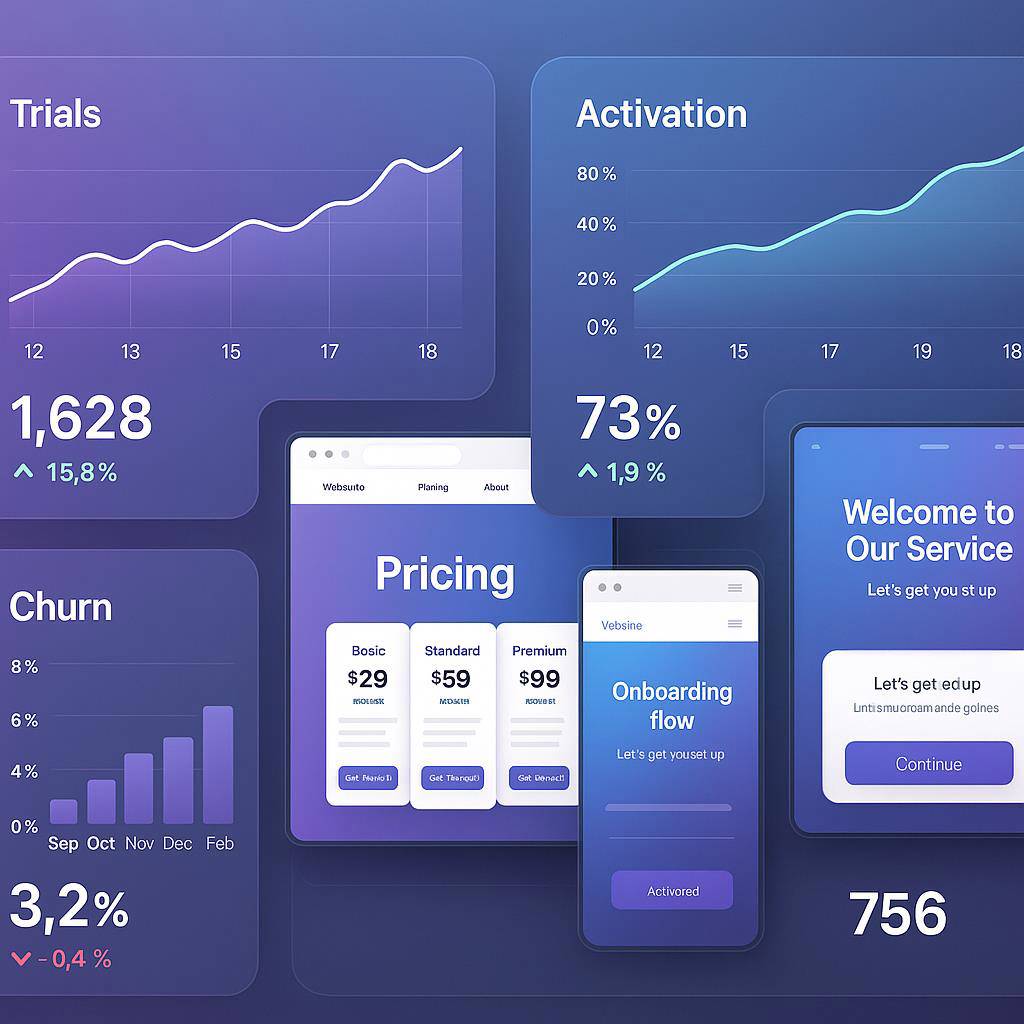
What a specialized SaaS growth engine looks like
The SaaS growth playbook is unforgiving to siloed teams and vanity metrics. Winning companies run an integrated growth engine where product, marketing, sales, and success operate from a shared data layer and a single revenue narrative. A specialized SaaS digital marketing agency helps orchestrate this, compounding gains across the entire lifecycle.
Expect AI-assisted research, privacy-resilient targeting, and PLG motions that blend seamlessly with sales-led enterprise expansion. Precision comes from rigorous experimentation and cohort analytics, not channel fads. The result is predictable pipeline, faster payback, and resilient net revenue retention.
- Acquisition: Search-led demand, high-intent PPC, and partner ecosystems.
- Activation: Frictionless onboarding, in-app prompts, and lifecycle email.
- Monetization: Pricing experiments, strategic upsells, and annualization.
- Retention: Churn diagnostics, CS feedback loops, and community.
- Analytics: Clear North-star metrics and cohort tracking by segment.
To accelerate execution, unify strategy with expert operators. See integrated packages via Digital Marketing Services and augment decisioning with AI Consulting for forecasting, pricing intelligence, and content velocity.
Quick Summary: PLG, paid, and lifecycle levers
Most SaaS growth in 2026 comes from three compounding levers: product-led growth, efficient paid acquisition, and rigorous lifecycle marketing. Align all three to one revenue model and you unlock sustainable scale.
- PLG: Design onboarding to reach first value fast, score PQLs, and route high-intent users to sales.
- Paid: Dominate intent with search and retargeting, defend your brand, and prune waste with negative keywords.
- Lifecycle: Precision emails, in-app nudges, and CS automation drive upgrades and reduce churn.
Layer experimentation on top: test messaging, pricing, and UX flows every sprint. Pair demand creation with demand capture for full-funnel efficiency.
Acquisition: SEO for feature pages, PPC for intent, partner programs
Search remains the highest-confidence discovery channel when executed for problem-solution fit. Build a feature-by-feature SEO architecture that maps to buyer pains and comparison intent. Each page should demonstrate value, social proof, and clear next steps.
- SEO feature pages: Cluster around capabilities (e.g., SSO, audit logs, workflows) and industries. Add FAQs, pricing snippets, and short explainer videos.
- Comparison and alternatives: Capture mid-funnel research with honest side-by-sides and migration guides.
- Technical excellence: Fast loads, structured data, internal linking, and schema for reviews and FAQs.
For demand capture at scale, deploy high-intent PPC with ruthless focus. Start with brand and core pain keywords, then expand to competitor and category terms you can win on quality score and landing experience.
- Intent-aligned campaigns: Map keywords to single-purpose landing pages with crisp CTAs.
- Guardrails: Negative keyword lists, geo/segment splits, and device bid adjustments.
- Creative: Responsive search ads with pinning tests and asset-level reporting.
Build leverage with partners: ecosystems, marketplaces, agencies, and integrations. Co-marketing and co-selling create efficient reach and authority, especially in enterprise segments.
- Marketplace optimization: Listings with video, case studies, and regular review capture.
- Co-marketing: Webinars and guides with shared MQL/SQL definitions and attribution.
- Revenue-sharing: Tiered incentives and clear enablement to activate partners.
Scale these motions with proven operators. Explore SEO Services for content and technical depth, and PPC Service for intent-led campaigns and A/B testing. For B2B pipeline alignment, see B2B Digital Marketing.
Activation: Onboarding UX, in-app prompts, email sequences
Activation is where revenue is won or lost. Design onboarding to deliver first value in minutes, not days, and personalize based on role, job-to-be-done, and plan tier. Instrument every step so you can see where users stall and why.
- Onboarding UX: Progressive profiling, empty-state education, and interactive product tours.
- Checklists: Time-to-value milestones with visual progress and celebratory moments.
- Environment setup: Opinionated defaults plus one-click integrations for data import.
Use in-app prompts to guide the next best action. Contextual suggestions outperform generic tooltips when tied to clear outcomes and social proof.
- Nudges: Trigger based on behavior (created first project, invited teammate, installed integration).
- Help overlays: Just-in-time micro-tutorials with skip and snooze controls.
- Experimentation: A/B test copy, placement, and timing by cohort.
Email remains your most controllable lifecycle channel. Build sequences for trial, freemium, and new paid users with distinct goals and deflection paths.
- Trial sequences: Day 0 value proof, mid-trial ROI calculator, and final-day urgency.
- Freemium nurture: Education-first plus episodic upgrade prompts when usage crosses thresholds.
- Rescue flows: Re-activation and “stuck user” playbooks driven by behavioral scoring.
Strengthen UX with UI/UX Design and orchestrate lifecycle programs via Email Marketing Services. Ensure landing experiences align with product through Website Development.
Monetization: Pricing tests, upsells, annualization
Pricing is a growth lever, not a one-time decision. Test packaging, price points, and billing models quarterly to keep alignment with perceived value. Localize for currency and willingness-to-pay by region and segment.
- Packaging: Align tiers to outcomes and admin needs, not feature bloat.
- Usage-based: Consider hybrid models (platform fee + usage blocks) for predictability.
- Price research: Van Westendorp, conjoint, and win/loss interviews for guardrails.
Engineer upsell paths inside the product and throughout the lifecycle. Surface value moments when upgrade friction is lowest and payoff is clear.
- Upgrade triggers: Seats, projects, API calls, or advanced permissions usage.
- In-product paywalls: Transparent limits, quick comparisons, and one-click upgrades.
- PQL to SQL: Route high-intent accounts to sales with context-rich notes.
Annualization strengthens cash flow and retention when positioned as value, not a discount gimmick. Offer annual options early, reinforce near value milestones, and support procurement workflows for larger deals.
- Prepay incentives: 10–20% savings tied to expanded value or services.
- Auto-renew with clarity: Reminders, usage summaries, and opt-out simplicity build trust.
- Expansion motions: Add-ons and cross-sells mapped to maturity stages.
Use AI Consulting to model price elasticity and predict revenue under different packaging scenarios.
Retention: Churn diagnostics, CS loops, community
Healthy NRR starts with understanding why customers leave and fixing root causes. Segment churn by cohort, use case, buyer size, and lifecycle stage. Combine quantitative signals with qualitative interviews to prioritize fixes.
- Instrumentation: Track pre-churn behaviors (logins, feature use, support volume).
- Churn coding: Categorize reasons (value gap, UX friction, budget, champion left).
- Win-back: Time-bound offers coupled with product updates addressing objections.
Customer success should run proactive plays, not just react. Tie success plans to measurable outcomes and schedule executive business reviews for strategic accounts.
- Playbooks: Onboarding, adoption, risk mitigation, and expansion sequences.
- Content: ROI templates, maturity scorecards, and use-case libraries.
- Community: User groups, office hours, and peer showcases to deepen engagement.
Community flywheels amplify brand and reduce support burden when thoughtfully moderated. Pair owned channels with social to meet users where they hang out.
- Social amplification: Run AMAs, creator partnerships, and feature drop campaigns via SMM Services.
- Lifecycle reinforcement: Use Email Marketing Services to distribute success stories and product tips.
- Enterprise care: Dedicated channels, SLAs, and roadmap previews for top accounts.
Analytics: North-star metrics and cohort tracks
Pick one North-star metric that captures delivered value and correlates with revenue. Everyone should know it, optimize toward it, and report deltas weekly. Ladder all sub-metrics to this anchor to avoid dashboard sprawl.
- Examples: Qualified workspaces active weekly, automations executed, reports shared, or seats collaborating.
- Lead/lag: Combine leading indicators (setup complete) with lagging ones (retention, expansion).
- Data quality: Event governance and naming standards to preserve signal.
Then analyze cohorts to see what actually compounds. Slice by acquisition source, persona, plan, industry, and geography. Compare time-to-value, upgrade rates, and churn curves over equal time windows.
- Channel view: SEO vs PPC vs partner cohorts by activation and LTV.
- Pricing view: Old vs new packaging impact on ARPA and NRR.
- Attribution: Use multi-touch models and MMM as sample sizes grow.
Automate insights and forecasting with ML where it beat heuristics. Connect experimentation to revenue impact, not just clicks or sign-ups.
- Cadence: Weekly growth reviews, monthly retros, quarterly strategy refresh.
- Ownership: Clear DRI per metric with documented hypotheses and next tests.
- Support: Bring in AI Consulting to build predictive LTV and churn propensity models.
Recommended Partner: SaaS Digital Marketing Agency by TMAT Network
If you want a partner fluent in PLG and enterprise motions, explore the SaaS Digital Marketing Agency by TMAT Network. The team integrates strategy, creative, media, and product growth—measured by revenue, not impressions.
- Search and content engine: Full-stack SEO with SEO Services for feature pages, comparisons, and technical excellence.
- Intent-led media: Scaled capture with PPC Service, including brand defense and high-intent expansions.
- Lifecycle orchestration: Behavioral nurture via Email Marketing Services and product-integrated flows.
- Experience design: Conversion-focused UI/UX Design and Website Development to align ads, site, and product.
- Analytics + AI: Governance, dashboards, and predictive models with AI Consulting.
TMAT’s operating cadence blends rapid experimentation with quarterly strategy resets. Expect clear roadmaps, weekly reporting, and shared KPIs across the full funnel.
Conclusion: Compound growth across the full funnel — book a SaaS audit
Compounding growth comes from aligning product, marketing, sales, and success around one plan. In 2026, the edge belongs to teams that test quickly, understand cohorts deeply, and personalize every step from click to renewal.
If you’re ready to audit gaps and prioritize the highest-leverage wins, schedule a working session with the TMAT Network SaaS digital marketing agency. You’ll leave with a 90-day roadmap tied to revenue impact.
- Deliverables: Channel diagnostics, activation teardown, pricing opportunities, and retention risks.
- Artifacts: Cohort baseline, experiment backlog, and forecast scenarios.
- Next steps: Sprint plan with owners, metrics, and dates to make momentum inevitable.
FAQ: CAC payback targets? Freemium vs trials? Best-performing channels? Churn benchmarks? Attribution tips?
What CAC payback should a SaaS aim for in 2026?
Targets vary by ACV and segment, but efficient teams typically land:
- PLG/SMB: 3–9 months when activation is strong and expansion is healthy.
- Mid-market: 9–15 months depending on sales assist and partner mix.
- Enterprise: 12–24 months with multi-threaded deals and procurement.
Monitor payback by channel and cohort, not blended averages. Reallocate budget every quarter to protect payback discipline.
Freemium or time-limited trials?
Both work—choose based on value discovery speed and support costs.
- Freemium: Best when core value is instantly visible and usage creates network or data moats. Requires strong in-product upgrade paths.
- Trials (7–21 days): Best when setup is guided and value appears after a few key actions. Pair with white-glove onboarding for high-ACV cohorts.
Hybrid models (usage-limited freemium + trials for premium features) are common in 2026.
Which channels perform best for B2B SaaS?
Top performers remain:
- SEO: Feature and comparison pages compound demand capture over time. See SEO Services.
- PPC: High-intent search and smart retargeting with strict negatives. See PPC Service.
- Partners: Integrations and marketplaces that accelerate trust and adoption.
Owned content and community drive durable, low-CAC assists across the funnel.
What are realistic churn benchmarks?
Benchmarks vary widely, but directional ranges:
- Logo churn (annual): SMB 15–25%, Mid-market 8–15%, Enterprise 2–8%.
- Gross revenue churn (annual): Aim for <10% in mid-market and <5% in enterprise.
- Net revenue retention (NRR): 100–120% is solid; 120%+ is elite with strong expansion.
Track churn by reason code and cohort, then prioritize fixes where revenue at risk is highest.
Attribution tips for multi-touch SaaS journeys?
Use multiple lenses rather than a single “truth.”
- Near-term: Multi-touch rules (position-based, time decay) to guide weekly optimization.
- Strategic: Media mix modeling as data matures to value upper-funnel investments.
- Lift tests: Geo and audience holdouts to validate incremental impact.
Tag offline touches (events, SDR calls) and unify IDs to connect the dots. Align models to decisions: channel budgets, creative testing, and sales routing.


 Quick Response